Read time: 8 min read
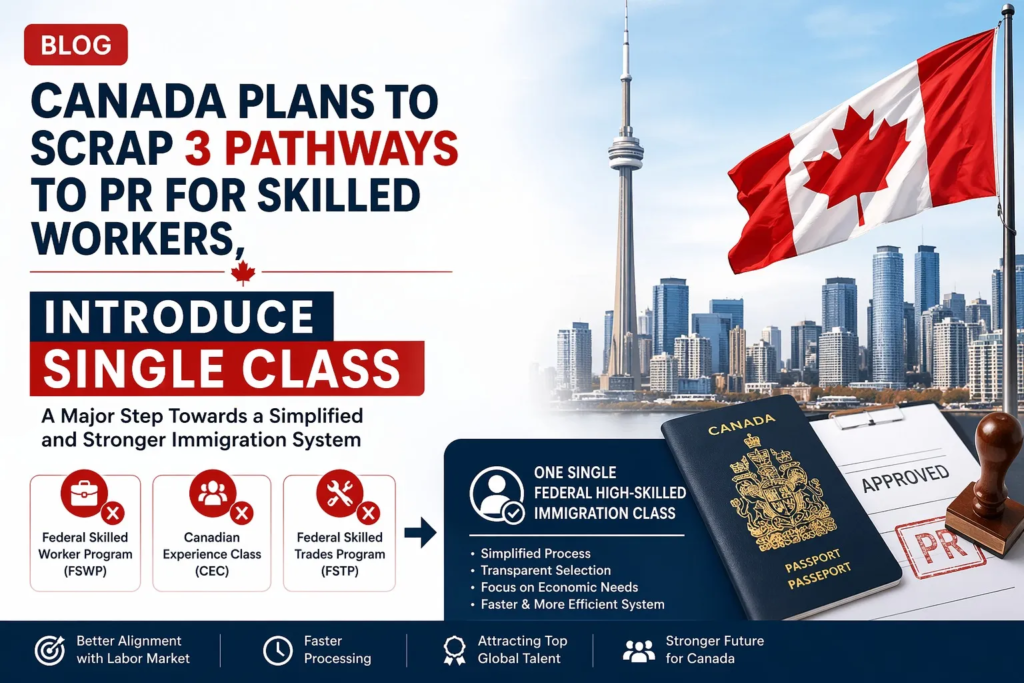
Canada Is Planning One of Its Biggest PR System Reforms
Canada is preparing for a major immigration restructuring that could reshape how skilled workers apply for permanent residence.
Based on recent IRCC policy direction, the government is exploring a shift from multiple Express Entry streams to one simplified pathway focused on labour market needs.
This is still in the proposal and consultation stage, but it is important for candidates to prepare early because profile strength will matter even more.
- Proposed goal: simpler and faster PR processing
- Main focus: stronger economic contribution by selected candidates
- Likely impact: higher competition for low-scoring or weak profiles
Which Express Entry Programs Could Be Removed?
The proposed reform discusses replacing three core pathways currently used by skilled professionals since 2015.
- Federal Skilled Worker Program (FSWP)
- Canadian Experience Class (CEC)
- Federal Skilled Trades Program (FSTP)
What Could Replace Them?
Instead of separate routes, Canada may introduce a single skilled worker intake model with common eligibility standards.
The intent is to reduce confusion for applicants and align selection decisions with real labour shortages across provinces and industries.
- One integrated pathway for skilled worker profiles
- Simplified eligibility rules and transparent selection criteria
- More emphasis on employability, not just basic CRS score factors
Why Is Canada Moving Toward This Model?
Canada is trying to make immigration outcomes more predictable for the economy and easier to manage at policy level.
- Simplification: fewer overlapping streams and less applicant confusion
- Economic targeting: better matching of skills to labour demand
- Faster processing: reduced system complexity can cut delays
- Quality selection: preference for candidates who can contribute quickly
What Changes Should Applicants Expect?
Final rules are not published yet, but early policy signals suggest a tighter and more performance-driven system.
- Standardized baseline criteria for all skilled applicants
- Minimum benchmarks for language and education
- At least one category of skilled work experience likely required
- Stronger preference for Canadian work experience and higher wages
- Potentially higher value for valid job offers in Canada
Is This Final Already?
No. This is currently policy direction and proposal-stage discussion.
Public consultations are expected during 2026, and implementation may take 12 to 18 months once final design is approved.
- Status: not final yet
- Consultations: expected in 2026
- Implementation horizon: around 12 to 18 months after finalization
What It Means for Students and Skilled Workers
This reform direction can benefit candidates already in Canada with local qualifications and work history.
For overseas applicants, competition may rise, especially where profiles are weak in language score, experience quality, or job alignment.
- Students in Canada may get stronger PR positioning with Canadian credentials
- Skilled workers with strong salaries and job offers may gain priority
- Trades and mid-skilled occupations may see category redesign based on labour demand
VisionWay Expert View: Prepare Early, Compete Better
Canada appears to be moving from a quantity-based intake to a quality-based selection approach.
For applicants, this means profile optimization is no longer optional. IELTS or PTE scores, job relevance, salary strength, and verified work experience will carry more weight.
- Improve language score and documentation quality now
- Build role-relevant work experience and career progression proof
- Target occupations with stronger demand and better wage outcomes
- Take expert profile assessment before rule changes go live
Final Takeaway
If this proposal is implemented, Canada PR applications may become simpler to understand but more selective in practice.
Candidates who prepare early will be in a much stronger position when new rules are launched.
- Strengthen your profile now
- Track IRCC updates closely
- Apply with a strategy, not assumptions