Visionway
Apply Now Enquire Now Book Appointment

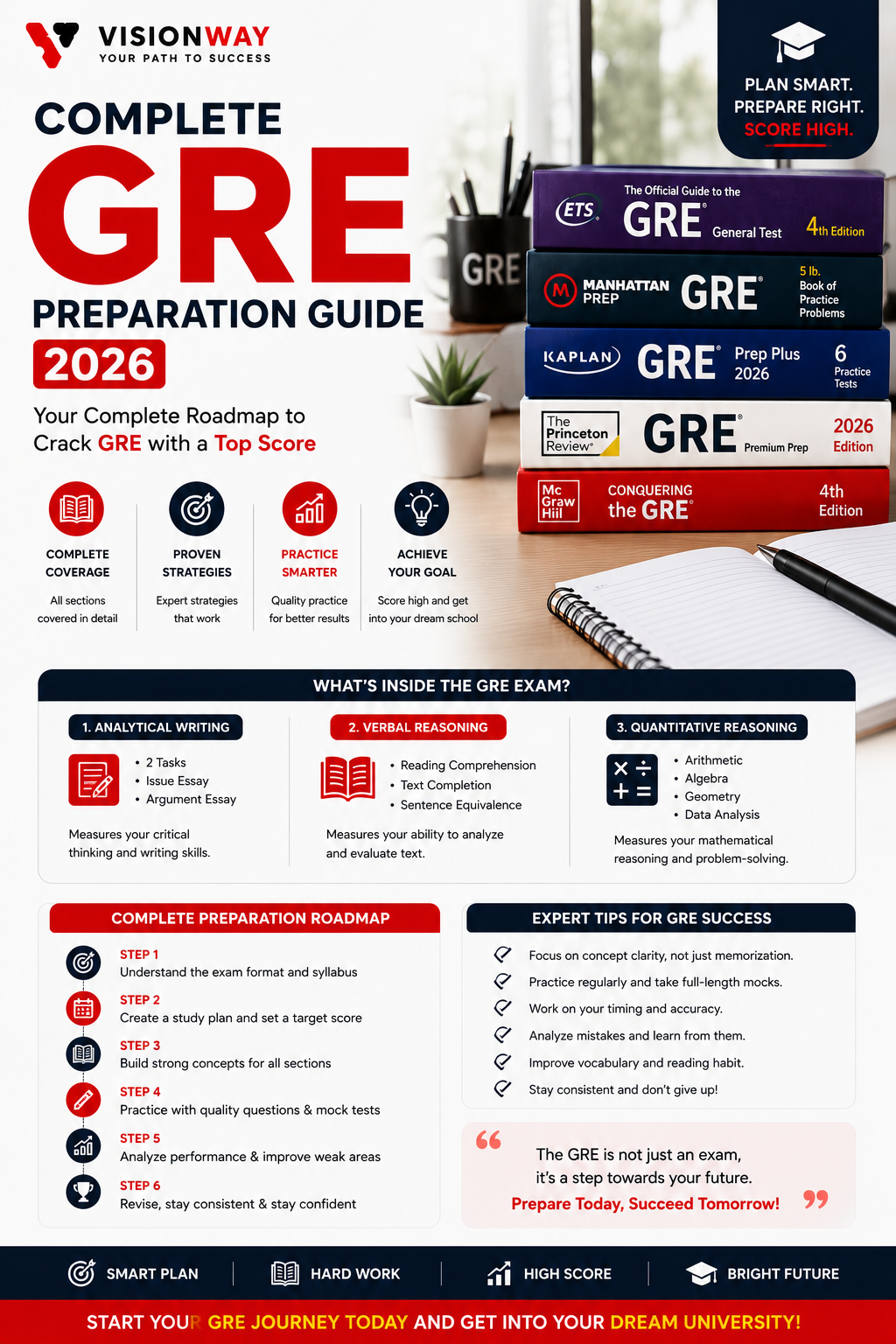
Complete GRE Preparation Guide 2026

Introduction

The Graduate Record Examination (GRE) is one of the most widely accepted standardized tests for admission to Master’s, MBA, and PhD programs across the world. Thousands of universities in countries like the USA, Canada, the UK, Australia, Germany, Ireland, and New Zealand accept GRE scores as part of their admission requirements.

A good GRE score can strengthen your university application, improve scholarship opportunities, and increase your chances of admission to top-ranked institutions.

This comprehensive guide explains everything you need to know about the GRE exam, including its format, syllabus, scoring system, preparation strategy, study plan, recommended books, and expert tips.


What is the GRE?

The Graduate Record Examination (GRE) is a standardized test conducted by the Educational Testing Service (ETS). It evaluates a candidate’s readiness for graduate-level education by assessing verbal reasoning, quantitative reasoning, analytical writing, and critical thinking skills.

The GRE is accepted by thousands of universities and business schools worldwide.


Who Should Take the GRE?

The GRE is suitable for students planning to pursue:

  • Master’s Programs (MS, MSc, MEng)
  • MBA Programs
  • PhD Programs
  • Specialized Graduate Degrees
  • Scholarship Applications (where GRE scores are accepted)

Countries Accepting GRE Scores

GRE scores are accepted in many countries, including:

  • United States
  • Canada
  • United Kingdom
  • Australia
  • Germany
  • Ireland
  • New Zealand
  • Singapore
  • Netherlands
  • France

Always verify the latest admission requirements on the official university website.


GRE Exam Pattern

The GRE General Test consists of three main sections.

SectionNumber of QuestionsDuration
Analytical Writing1 Essay30 Minutes
Verbal Reasoning27 Questions41 Minutes
Quantitative Reasoning27 Questions47 Minutes

Total Test Duration: Approximately 2 Hours

The GRE is computer-based in most test centers.


GRE Syllabus

Analytical Writing

This section measures your ability to:

  • Analyze an issue
  • Organize ideas logically
  • Support arguments
  • Use standard written English

Verbal Reasoning

Tests your:

  • Reading Comprehension
  • Critical Reasoning
  • Text Completion
  • Sentence Equivalence
  • Vocabulary

Quantitative Reasoning

Topics include:

  • Arithmetic
  • Algebra
  • Geometry
  • Data Analysis
  • Word Problems
  • Probability
  • Statistics

GRE Scoring System

Each section is scored separately.

SectionScore Range
Verbal Reasoning130–170
Quantitative Reasoning130–170
Analytical Writing0–6

The highest possible combined GRE score is 340 (excluding the Analytical Writing score).


What is a Good GRE Score?

ScoreCompetitiveness
325+Excellent
320–324Very Good
315–319Good
310–314Competitive
Below 310Needs Improvement

Score requirements vary by university and program.


Step-by-Step GRE Preparation Strategy

Step 1: Understand the Exam Format

Before you begin studying:

  • Learn the test structure
  • Understand question types
  • Review scoring criteria
  • Familiarize yourself with the exam interface

Step 2: Take a Diagnostic Test

Attempt a full-length practice test to assess your:

  • Quantitative skills
  • Vocabulary
  • Reading ability
  • Time management
  • Analytical writing

Identify your weak areas and focus on improving them.


Step 3: Set a Target Score

Research the universities you plan to apply to and determine their average GRE score requirements.

Example:

ProgramRecommended Score
MS in Computer Science320+
MBA315+
Engineering320+
Business Analytics320+

Section-wise Preparation Guide

Analytical Writing

Preparation Tips

  • Practice one essay every alternate day.
  • Learn essay structure.
  • Support arguments with examples.
  • Improve grammar and vocabulary.
  • Read high-scoring sample essays.

Verbal Reasoning

Preparation Tips

  • Learn 20–30 new words daily.
  • Practice Reading Comprehension passages.
  • Improve sentence completion skills.
  • Read newspapers and journals.
  • Revise vocabulary regularly.

Quantitative Reasoning

Preparation Tips

  • Revise basic mathematics concepts.
  • Memorize important formulas.
  • Practice data interpretation.
  • Solve timed quizzes.
  • Analyze mistakes after every mock test.

Best GRE Preparation Books

The following books are highly recommended:

  • The Official Guide to the GRE General Test (ETS)
  • Official GRE Verbal Reasoning Practice Questions
  • Official GRE Quantitative Reasoning Practice Questions
  • Manhattan Prep GRE Strategy Guides
  • Kaplan GRE Prep Plus
  • Princeton Review GRE Premium Prep
  • Barron’s GRE

Using official ETS material along with one comprehensive preparation book provides excellent coverage of the exam.


Best Online GRE Resources

Supplement your preparation with:

  • Official ETS practice tests
  • Vocabulary flashcards
  • Timed mock exams
  • Formula sheets
  • Essay samples
  • Online study groups

8-Week GRE Study Plan

Week 1

  • Understand exam format
  • Take a diagnostic test
  • Build a study schedule

Week 2

  • Arithmetic
  • Vocabulary
  • Reading Comprehension

Week 3

  • Algebra
  • Geometry
  • Sentence Equivalence

Week 4

  • Data Analysis
  • Analytical Writing
  • Practice tests

Week 5

  • Full-length mock test
  • Review mistakes
  • Improve weak sections

Week 6

  • Advanced Quant
  • Critical Reading
  • Essay writing

Week 7

  • Mock tests
  • Time management
  • Revision

Week 8

  • Final revision
  • Vocabulary review
  • Formula revision
  • Confidence building

Time Management Tips

During the exam:

  • Do not spend too much time on one question.
  • Skip difficult questions and return later if needed.
  • Practice solving questions under timed conditions.
  • Read instructions carefully.
  • Maintain a steady pace throughout the test.

Common GRE Preparation Mistakes

Avoid these mistakes:

  • Ignoring official ETS study materials
  • Memorizing formulas without understanding concepts
  • Skipping mock tests
  • Focusing only on Quant or Verbal
  • Neglecting Analytical Writing
  • Learning vocabulary without revision
  • Poor time management

How Long Should You Prepare?

Current Skill LevelPreparation Time
Beginner3–4 Months
Intermediate2–3 Months
Advanced6–8 Weeks

Consistency is more important than studying for long hours occasionally.


Tips to Improve Your GRE Score

  • Study consistently every day.
  • Build vocabulary gradually.
  • Focus on concept clarity.
  • Practice under exam conditions.
  • Analyze mistakes after every mock test.
  • Revise formulas and vocabulary weekly.
  • Attempt full-length practice exams regularly.

Exam Day Tips

Before your GRE exam:

  • Reach the test center early.
  • Carry valid identification.
  • Stay calm and confident.
  • Read every question carefully.
  • Manage your time effectively.
  • Avoid rushing through easy questions.

Frequently Asked Questions

Is the GRE difficult?

The GRE is challenging, but with a structured study plan, consistent practice, and the right resources, most students can achieve competitive scores.


How many months are required for GRE preparation?

Most students prepare for 2–4 months, depending on their academic background and target score.


Is coaching necessary for GRE?

Not necessarily. Many students prepare successfully using official ETS books, online resources, and regular mock tests. Coaching can be helpful if you need personalized guidance.


What is a competitive GRE score?

A score of 320 or above is considered competitive for many top universities, though requirements vary by program.


Can I retake the GRE?

Yes. You can take the GRE multiple times, subject to ETS policies. Many applicants improve their scores on a second attempt after additional preparation.


Related Resources

Continue your preparation with these helpful guides:

  • Best GRE Preparation Books 2026
  • SOP for Masters
  • LOR Guide
  • Study in USA Guide
  • Study in Canada Guide
  • TOEFL Preparation Guide
  • IELTS Preparation Guide
  • GMAT Preparation Guide

Need Expert Guidance for Your Study Abroad Journey?

A strong GRE score is only one part of your graduate school application. Choosing the right universities, preparing a compelling Statement of Purpose (SOP), securing Letters of Recommendation (LOR), and understanding visa requirements are equally important.

At VisionWay, our experienced study abroad counsellors provide personalized guidance to help you plan every step of your journey—from GRE preparation to university admissions and visa applications.

Book Your Free Counselling Session Today

Get expert advice on GRE preparation, university selection, scholarships, SOP writing, and admissions to move closer to your dream university.
Best GRE Preparation Books 2026

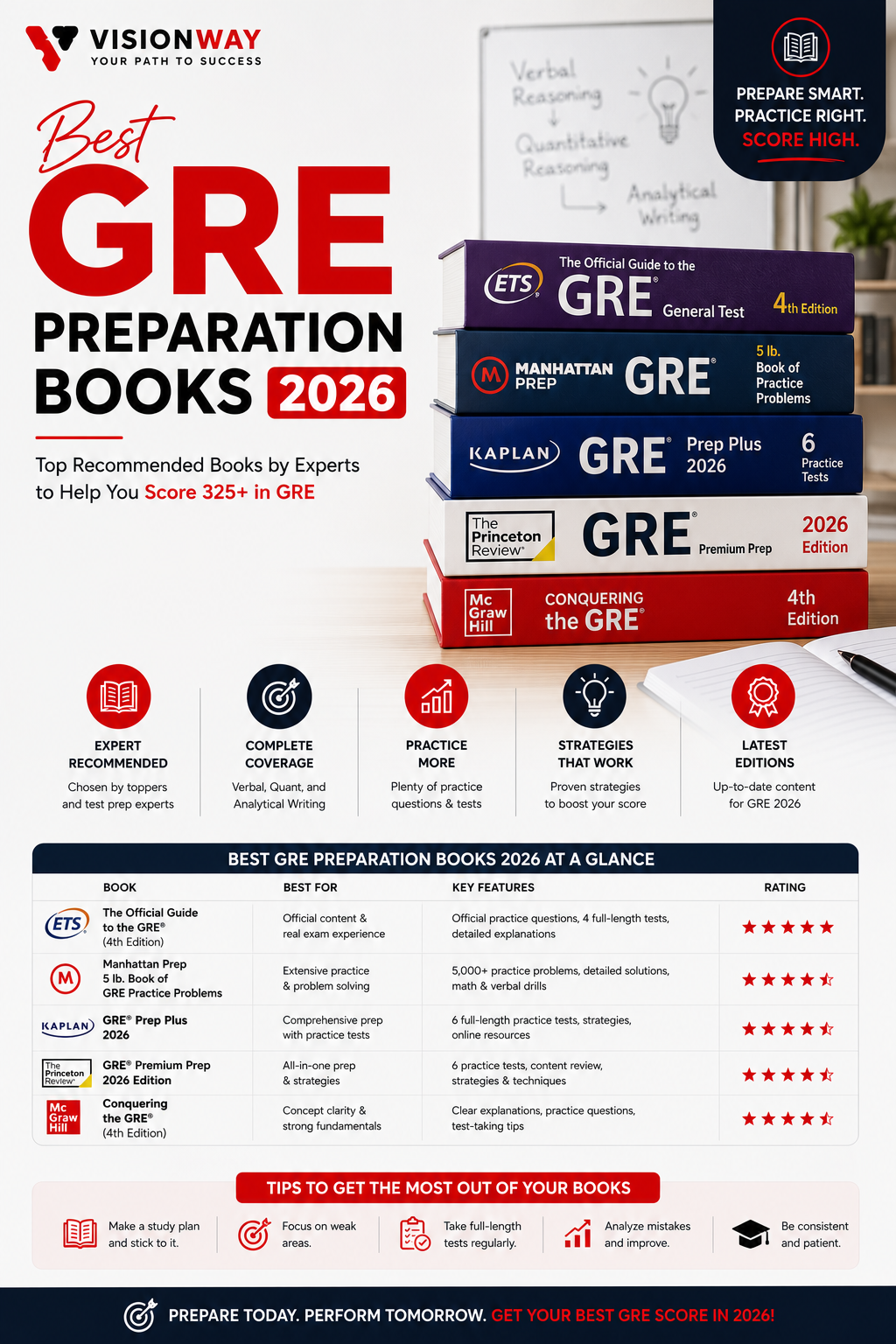
Preparing for the Graduate Record Examination (GRE) is an important step for students planning to pursue Master’s, MBA, or PhD programs at universities worldwide. A high GRE score can strengthen your application and improve your chances of admission to top-ranked institutions.

The right preparation books can help you understand the GRE exam pattern, improve your quantitative and verbal reasoning skills, and build confidence through realistic practice tests. In this guide, we’ll explore the best GRE preparation books for 2026 and explain which resources are most suitable for different learning levels.


Why Choosing the Right GRE Book Matters

A well-structured GRE preparation book helps you:

  • Understand the latest GRE exam format
  • Master Quantitative and Verbal Reasoning
  • Improve Analytical Writing skills
  • Learn proven test-taking strategies
  • Practice with realistic mock tests
  • Identify strengths and weaknesses

Using updated study materials ensures you’re preparing according to the latest GRE syllabus and question patterns.


Top GRE Preparation Books for 2026

1. The Official Guide to the GRE General Test (ETS)

Best For: Authentic Practice & Official Questions

Published by ETS (Educational Testing Service), the organization that conducts the GRE, this is considered the most reliable preparation book.

Key Features

  • Official GRE questions
  • Complete exam overview
  • Three full-length practice tests
  • Detailed answer explanations
  • Analytical Writing samples
  • Latest exam pattern

Recommended For: All GRE aspirants


2. Official GRE Quantitative Reasoning Practice Questions

Best For: Quant Section Preparation

This book focuses exclusively on Quantitative Reasoning and contains official ETS questions with detailed explanations.

Covers

  • Arithmetic
  • Algebra
  • Geometry
  • Data Analysis
  • Word Problems
  • Practice Sets

3. Official GRE Verbal Reasoning Practice Questions

Best For: Verbal Preparation

Ideal for improving:

  • Reading Comprehension
  • Text Completion
  • Sentence Equivalence
  • Vocabulary
  • Critical Reasoning

4. Manhattan Prep GRE Strategy Guides

Best For: High Scores (320+)

Manhattan Prep is widely recommended for students aiming for top GRE scores.

Features

  • Advanced Quant concepts
  • Detailed Verbal strategies
  • Step-by-step solutions
  • Practice questions
  • Time-saving techniques

Suitable for students targeting competitive universities.


5. Kaplan GRE Prep Plus

Kaplan offers comprehensive GRE preparation with detailed lessons and online practice resources.

Includes

  • Full-length mock tests
  • Online video lessons
  • Practice questions
  • Study plans
  • Strategy guides

6. Princeton Review GRE Premium Prep

Known for its easy-to-understand explanations, Princeton Review is an excellent option for beginners.

Highlights

  • Practice tests
  • Writing strategies
  • Vocabulary building
  • Time management tips
  • Online resources

7. Barron’s GRE

Barron’s is popular for strengthening vocabulary and analytical reasoning.

It includes:

  • Vocabulary lists
  • Quantitative exercises
  • Writing samples
  • Practice tests

Comparison of the Best GRE Books

BookBest ForOfficial QuestionsPractice Tests
Official GRE GuideOverall Preparation3
ETS Quant GuideQuantitative SectionSection Tests
ETS Verbal GuideVerbal SectionSection Tests
Manhattan PrepAdvanced PreparationMultiple
Kaplan GRE Prep PlusComplete CourseMultiple
Princeton ReviewBeginnersMultiple
Barron’s GREVocabularyYes

Which GRE Book Should You Choose?

Beginners

  • Official GRE Guide
  • Princeton Review GRE
  • Kaplan GRE Prep

Intermediate Students

  • Official GRE Guide
  • Kaplan GRE Prep Plus
  • ETS Quant Guide

Advanced Students (Target Score 320+)

  • Manhattan Prep
  • Official GRE Guide
  • ETS Verbal Guide
  • ETS Quant Guide

Best GRE Vocabulary Books

A strong vocabulary is essential for scoring well in the GRE Verbal section.

Recommended resources:

  • Manhattan GRE Vocabulary
  • Barron’s GRE Vocabulary
  • GRE Vocabulary Flashcards
  • Word Power Made Easy (Norman Lewis)

Daily vocabulary practice can significantly improve Reading Comprehension and Sentence Equivalence performance.


Free GRE Study Resources

Along with preparation books, students should use:

  • Official GRE Practice Tests
  • Vocabulary Flashcards
  • Analytical Writing Samples
  • Quantitative Practice Sets
  • Online Timed Mock Tests
  • Study Planners

These resources help reinforce concepts learned from books and improve exam readiness.


8-Week GRE Study Plan

Week 1–2

  • Understand the GRE format
  • Take a diagnostic test
  • Review basic Quant concepts
  • Build daily vocabulary

Week 3–4

  • Practice Verbal Reasoning
  • Solve Quantitative questions
  • Learn Analytical Writing structure

Week 5–6

  • Take full-length mock tests
  • Analyze mistakes
  • Improve weak areas

Week 7–8

  • Revise all topics
  • Practice under timed conditions
  • Focus on speed and accuracy

Tips for Using GRE Books Effectively

  • Create a daily study schedule.
  • Complete one chapter at a time.
  • Practice under timed conditions.
  • Review mistakes after every mock test.
  • Learn new vocabulary every day.
  • Revise important formulas regularly.
  • Focus on concept clarity instead of memorization.

Common Mistakes Students Make

Avoid these common errors:

  • Ignoring official ETS material
  • Focusing only on Quant or Verbal
  • Skipping Analytical Writing practice
  • Taking mock tests without reviewing errors
  • Learning vocabulary without context
  • Poor time management

Frequently Asked Questions

Which is the best GRE preparation book?

The Official Guide to the GRE General Test by ETS is considered the most reliable resource because it contains authentic GRE questions and follows the official exam format.


Is one GRE book enough?

The Official Guide provides an excellent foundation, but combining it with a Quantitative or Verbal practice book can help you prepare more thoroughly.


Which book is best for GRE Quant?

The Official GRE Quantitative Reasoning Practice Questions book and Manhattan Prep Strategy Guides are among the best choices for improving quantitative skills.


Which GRE vocabulary book is recommended?

Word Power Made Easy by Norman Lewis and Barron’s GRE Vocabulary are highly recommended for building a strong vocabulary.


How long should I prepare for the GRE?

Most students prepare for 2–4 months, depending on their current skill level and target score.


Related Resources

Continue your preparation with these helpful guides:

  • Complete GRE Preparation Guide
  • Best GMAT Preparation Books
  • Best TOEFL Preparation Books
  • Best IELTS Preparation Books
  • Statement of Purpose (SOP) Guide
  • Letter of Recommendation (LOR) Guide
  • Study in USA Guide
  • Study in Canada Guide

Need Expert Guidance for Studying Abroad?

Preparing for the GRE is only one part of your journey. Choosing the right university, preparing a strong application, and securing a student visa are equally important.

At VisionWay, our experienced study abroad counsellors provide personalized guidance for GRE preparation, university selection, scholarship opportunities, SOP writing, and the complete admission process.

Book Your Free Counselling Session Today

Take the next step toward your dream university with expert support from VisionWay.

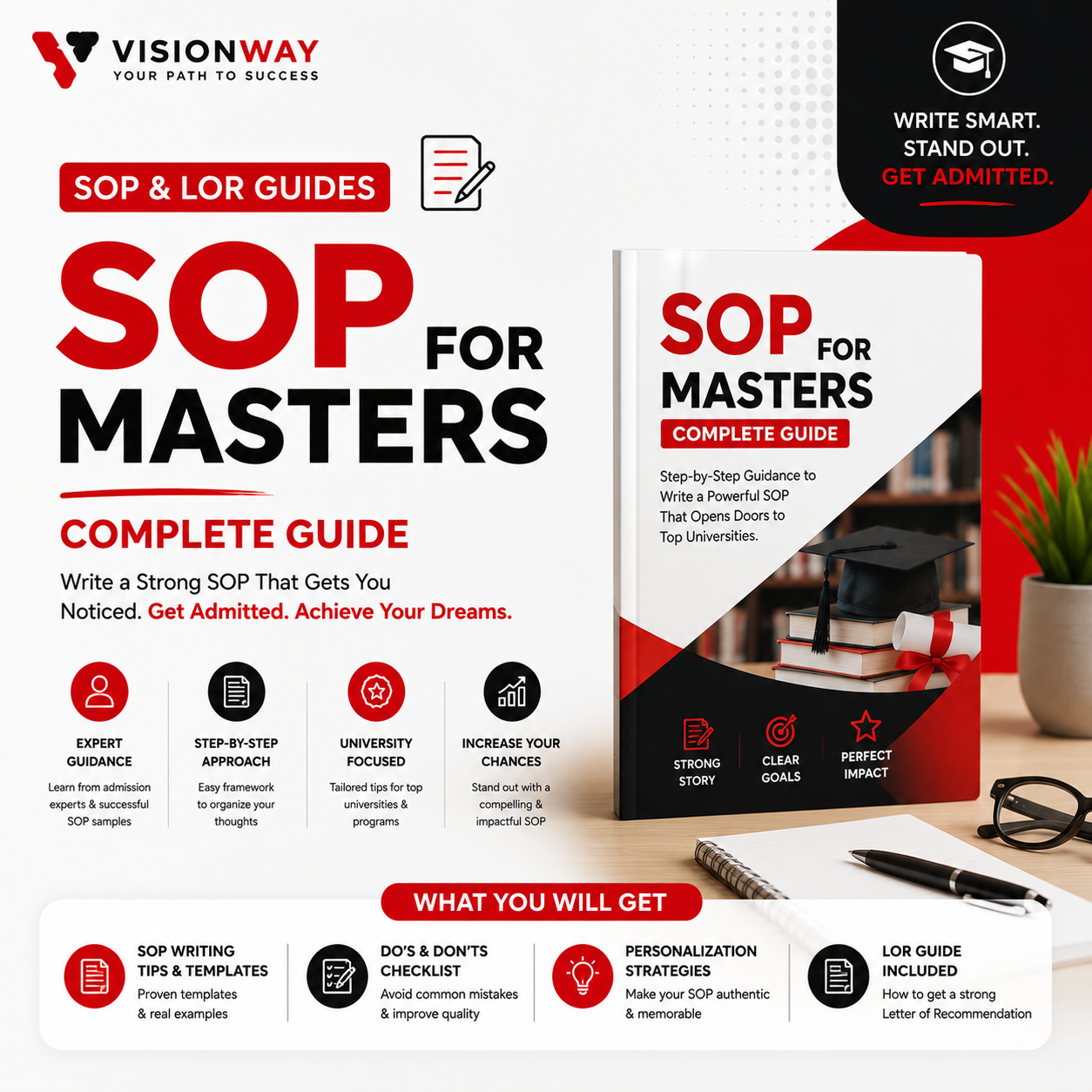
SOP for Masters: Complete Guide

Introduction

A Statement of Purpose (SOP) is one of the most important documents required when applying for a Master’s degree abroad. It allows you to showcase your academic background, career goals, achievements, and reasons for choosing a particular university and program.

Unlike your academic transcripts or resume, an SOP tells your unique story. A well-written SOP can significantly improve your chances of securing admission to top universities in countries such as Canada, the UK, Australia, Germany, Ireland, New Zealand, and the USA.

This comprehensive guide explains everything you need to know about writing an effective SOP for a Master’s program, including the format, structure, writing tips, and common mistakes to avoid.


What is an SOP for Masters?

An SOP for a Master’s degree is a personal essay submitted with your university application. It explains:

  • Your academic background
  • Professional experience (if applicable)
  • Career objectives
  • Motivation for pursuing the chosen course
  • Reasons for selecting a specific university
  • Future plans after graduation

The admission committee uses your SOP to evaluate your motivation, communication skills, and suitability for the program.


Why is an SOP Important?

A strong SOP helps universities understand who you are beyond your grades.

Benefits of a Well-Written SOP

  • Demonstrates your passion for the chosen field
  • Highlights your academic achievements
  • Explains your career aspirations
  • Shows why you are a good fit for the university
  • Differentiates you from other applicants

A compelling SOP can make a significant difference, especially when applicants have similar academic profiles.


Ideal SOP Length

Although requirements vary by university, the recommended length is:

RequirementRecommendation
Word Count800–1,200 words
Pages1–2 Pages
FontTimes New Roman or Arial
Font Size11–12 pt
Line Spacing1.5

Always follow the university’s official guidelines if specific instructions are provided.


Structure of an SOP for Masters

A well-organized SOP typically consists of the following sections:

1. Introduction

Start with a compelling introduction that captures the reader’s attention.

Explain:

  • Your interest in the chosen field
  • What inspired your career path
  • Why you decided to pursue higher education

Avoid using clichés or overly dramatic statements.


2. Academic Background

Describe your educational journey.

Include:

  • Degree completed
  • University or college
  • Major subjects
  • Academic achievements
  • Relevant projects
  • Research work
  • Certifications

Explain how your education prepared you for your Master’s program.


3. Professional Experience (If Applicable)

If you have work experience, discuss:

  • Job role
  • Responsibilities
  • Skills gained
  • Industry exposure
  • Projects completed
  • Leadership experience

Relate your experience to your future academic goals.


4. Why This Course?

Explain:

  • Why you selected this program
  • What interests you most
  • Which subjects you want to study
  • How the curriculum aligns with your goals

Be specific rather than making generic statements.


5. Why This University?

Admission officers want to know why you selected their institution.

Mention:

  • Faculty members
  • Research opportunities
  • Laboratories
  • Curriculum
  • Rankings
  • Industry collaborations
  • Internship opportunities
  • Campus facilities

Demonstrate that you have researched the university thoroughly.


6. Career Goals

Clearly explain your:

Short-Term Goals

Examples:

  • Become a Data Analyst
  • Work in Artificial Intelligence
  • Join a multinational company
  • Build technical expertise

Long-Term Goals

Examples:

  • Lead technology projects
  • Become a Research Scientist
  • Launch your own company
  • Contribute to innovation in your country

Universities appreciate applicants with clear career plans.


7. Conclusion

End your SOP confidently.

Summarize:

  • Why you are a suitable candidate
  • Why the university should consider your application
  • Your enthusiasm for joining the program

Finish with a positive and professional tone.


Sample SOP Structure

Introduction


Academic Background


Projects & Achievements


Professional Experience


Why This Course?


Why This University?


Career Goals


Conclusion

Writing Tips for an Impressive SOP

Follow these best practices:

  • Be honest and authentic.
  • Tell your personal story.
  • Maintain a logical flow.
  • Use professional language.
  • Keep paragraphs concise.
  • Support claims with examples.
  • Proofread multiple times.
  • Customize the SOP for each university.

Common Mistakes to Avoid

Many applicants make avoidable errors such as:

  • Copying SOPs from the internet
  • Using AI-generated content without editing
  • Exaggerating achievements
  • Writing lengthy personal stories unrelated to academics
  • Grammatical mistakes
  • Repeating information from the resume
  • Ignoring university-specific requirements
  • Submitting the same SOP to every university

A personalized SOP is always more effective than a generic one.


Checklist Before Submitting Your SOP

✔ Clear introduction

✔ Strong academic background

✔ Relevant projects and achievements

✔ Career goals explained

✔ University-specific content

✔ Error-free grammar

✔ Proper formatting

✔ Within the required word limit

✔ Personalized and original


SOP Example (Short Sample)

“My interest in Computer Science began during my undergraduate studies, where I developed a strong foundation in programming and software development. Through academic projects and internships, I discovered my passion for Artificial Intelligence and Data Analytics. Pursuing a Master’s degree will allow me to deepen my technical expertise while gaining international exposure.

I am particularly interested in the Master’s program at XYZ University because of its industry-oriented curriculum, distinguished faculty, and emphasis on research. I believe this program will equip me with the knowledge and practical skills needed to contribute to innovative AI solutions in the future.

After completing my Master’s degree, I aim to work as a Data Scientist with a global technology company before eventually leading AI-driven projects that address real-world business challenges.”


Documents Required Along with SOP

When applying for a Master’s degree, universities often require:

  • Academic Transcripts
  • Degree Certificates
  • Resume/CV
  • Letters of Recommendation (LOR)
  • IELTS/PTE/TOEFL Scores
  • Passport Copy
  • Work Experience Certificate (if applicable)
  • Portfolio (for design-related programs)

Frequently Asked Questions

What is the ideal length of an SOP for Masters?

Most universities recommend an SOP between 800 and 1,200 words, unless a different limit is specified.


Can I use the same SOP for every university?

No. While your academic background may remain the same, you should tailor each SOP to the university and program by mentioning specific faculty, curriculum, or research opportunities.


Should I mention low grades in my SOP?

If your academic performance was affected by genuine circumstances, you can briefly explain the situation and focus on how you improved and what you learned from the experience.


Can work experience strengthen my SOP?

Yes. Relevant internships or professional experience can demonstrate practical skills, maturity, and commitment to your chosen field.


Is it acceptable to use AI to write my SOP?

AI can help you brainstorm ideas or improve grammar, but the final SOP should reflect your own experiences, goals, and writing style. Admission committees value authenticity.


Related Resources

Continue exploring these helpful guides:

  • Statement of Purpose (SOP) Complete Guide
  • SOP for MBA
  • SOP for PhD
  • Letter of Recommendation (LOR) Guide
  • Study in Canada
  • Study in the UK
  • Best IELTS Preparation Guide
  • Best PTE Preparation Guide

Need Professional SOP Assistance?

A well-crafted SOP can significantly improve your chances of admission to your dream university.

At VisionWay, our experienced study abroad experts provide personalized guidance for writing strong, university-specific Statements of Purpose that highlight your strengths, achievements, and career aspirations.

Book a Free SOP Review Today

Receive expert feedback, improve your application, and move one step closer to studying abroad with confidence.


SEO Suggestions

To maximize search visibility:

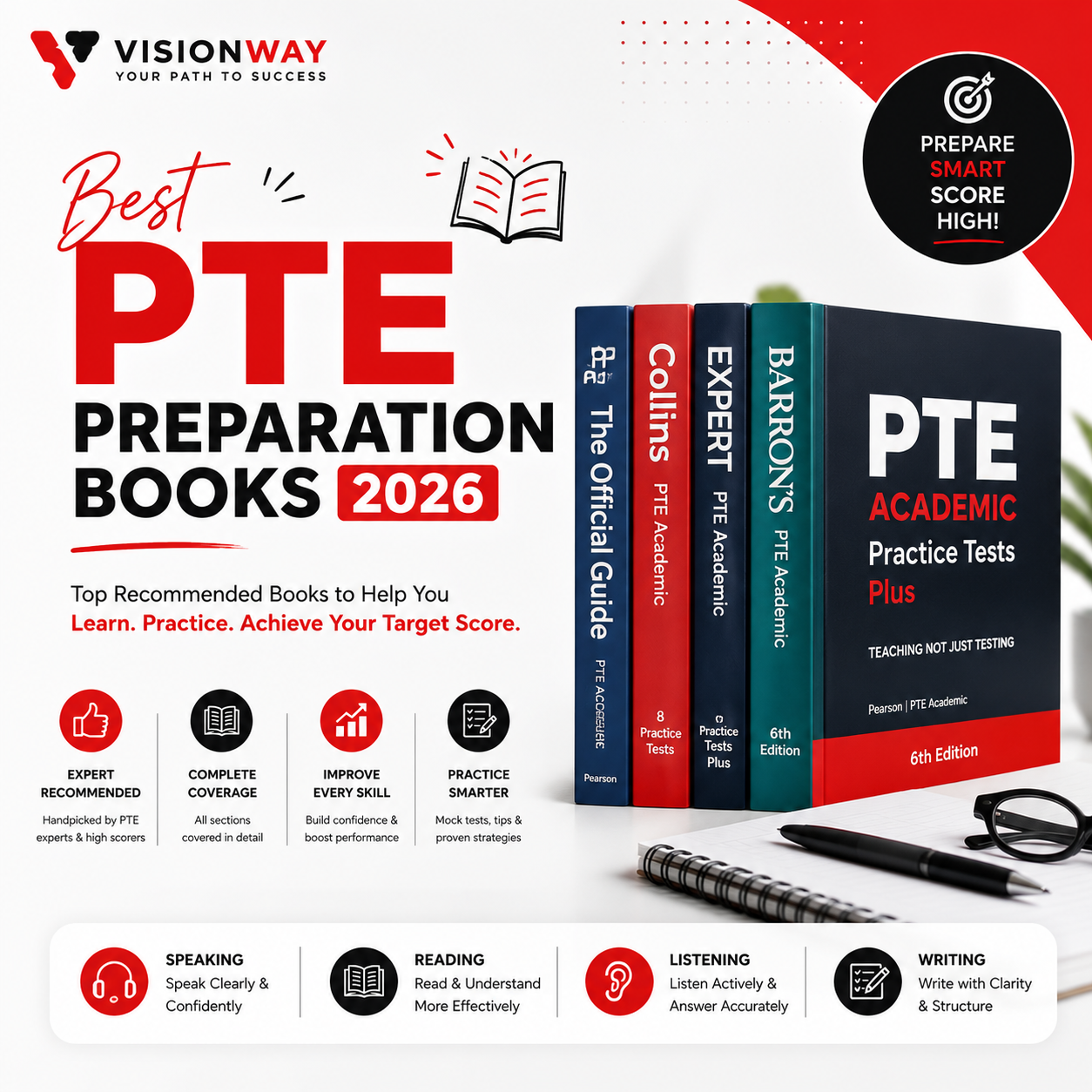
Best PTE Preparation Books 2026

Preparing for the Pearson Test of English (PTE Academic) requires more than just practicing questions—you need reliable study materials that reflect the latest exam pattern. Choosing the right books can help you understand question types, improve your English skills, and build confidence before test day.

This guide highlights the best PTE preparation books for beginners and advanced learners, including official Pearson publications, practice test books, and vocabulary resources.


Why Choosing the Right PTE Book Matters

A high-quality PTE preparation book helps you:

  • Understand the latest PTE Academic exam format
  • Practice all four skills: Speaking, Writing, Reading, and Listening
  • Learn effective strategies for every question type
  • Improve grammar, vocabulary, and pronunciation
  • Build confidence through full-length mock tests

Official study materials are especially valuable because they closely match the real exam format.


Our Top Recommendation

Pearson The Official Guide to PTE Academic

₹1,049•BookStation

₹1,049•BookStation

This is the best starting point for most students because it is published by Pearson, the organization that develops the PTE exam. It explains the test format, scoring, and question types, and includes practice questions plus access to digital learning resources.


Recommended PTE Books

Pearson The Official Guide to PTE Academic

Pearson The Official Guide to PTE Academic

₹1,049

BookStation

PTE Academic Practice Tests Plus with Key

PTE Academic Practice Tests Plus with Key

₹1,048.50

BookStation + others

The Official Guide to the Pearson Test of English Academic (2nd Edition)

The Official Guide to the Pearson Test of English Academic (2nd Edition)

₹1,038.56

amazon.in

The Complete PTE: Speaking, Listening, Reading & Writing

The Complete PTE: Speaking, Listening, Reading & Writing

₹449

amazon.in


1. The Official Guide to PTE Academic

Best For

Beginners and first-time test takers

Why We Recommend It

The Official Guide is the most trusted preparation book because it comes directly from Pearson. It explains every task type in detail and provides authentic practice questions that closely resemble the actual exam. It also includes digital resources such as question banks and practice activities.

Key Features

  • Official exam format
  • Detailed explanation of all question types
  • Practice exercises
  • Sample answers
  • Digital learning resources
  • Online question bank

Ideal Score

Suitable for students targeting PTE 50–90.


2. PTE Academic Practice Tests Plus

Best For

Mock Test Practice

This book focuses on realistic practice exams that simulate the actual PTE Academic test. It helps improve time management and familiarity with the computer-based testing environment.

Features

  • Full-length mock tests
  • Answer explanations
  • Practice for all modules
  • Performance evaluation

3. Expert PTE Academic Coursebook

Best For

Improving English Language Skills

This coursebook is ideal for students who want to strengthen grammar, vocabulary, and communication skills while preparing for the exam. It includes structured lessons and practice activities covering Speaking, Writing, Reading, and Listening.


4. The Complete PTE

Best For

Comprehensive Self-Study

This book covers all four PTE sections and provides additional exercises for students who want extra practice beyond official materials.

Includes

  • Speaking exercises
  • Writing practice
  • Reading comprehension
  • Listening activities
  • Sample questions

Comparison of the Best PTE Books

BookBest ForPractice TestsOfficial Material
Official Guide to PTE AcademicComplete preparation
Practice Tests PlusMock tests
Expert PTE Academic CoursebookSkill improvementLimited
The Complete PTESelf-study

Which Book Should You Choose?

Beginners

  • Official Guide to PTE Academic
  • Expert PTE Academic Coursebook

Intermediate Students

  • Official Guide
  • Practice Tests Plus

Advanced Students (Target Score 79+)

  • Official Guide
  • Practice Tests Plus
  • Additional full-length mock tests

Free PTE Study Resources

In addition to books, use official online preparation resources such as:

  • Official question banks
  • Scored practice tests
  • Test taker handbook
  • Sample questions
  • Digital learning resources

Pearson also offers free preparation materials and downloadable handbooks to help candidates understand the test and exam-day procedures.


Tips for Using PTE Books Effectively

  • Follow a daily study schedule.
  • Complete one chapter before moving to the next.
  • Take notes while studying.
  • Practice under timed conditions.
  • Review your mistakes after every mock test.
  • Focus on weak sections first.

Common Mistakes Students Make

  • Buying too many books at once.
  • Ignoring official Pearson materials.
  • Practicing without reviewing mistakes.
  • Skipping full-length mock tests.
  • Memorizing answers instead of understanding concepts.

Frequently Asked Questions

Which is the best PTE preparation book?

The Official Guide to PTE Academic is widely regarded as the best choice because it is created by Pearson and closely reflects the real exam.

Is one book enough for PTE preparation?

For many students, the Official Guide combined with regular mock tests is sufficient. Those aiming for very high scores may benefit from additional practice test books.

Which book is best for PTE Speaking?

The Official Guide, along with dedicated speaking practice and scored mock tests, provides strong preparation for the Speaking section.

How long should I study before taking the PTE?

Most candidates prepare for 6–12 weeks, depending on their current English level and target score.

Are official Pearson books worth buying?

Yes. They are written by the exam provider and are among the most reliable resources for understanding the latest exam pattern and practicing authentic question types.


Related Resources

Continue your preparation with these guides:

  • Complete PTE Preparation Guide
  • PTE Speaking Tips
  • PTE Writing Guide
  • PTE Reading Strategies
  • PTE Listening Practice
  • IELTS Preparation Guide
  • Best IELTS Preparation Books
  • Study in Australia Guide

Need Expert PTE Guidance?

Preparing for the PTE exam becomes much easier with expert support. At VisionWay, our experienced counsellors help students choose the right preparation strategy, understand university score requirements, and plan their study abroad journey with confidence.

Book your free counselling session today and take the next step toward achieving your target PTE score.

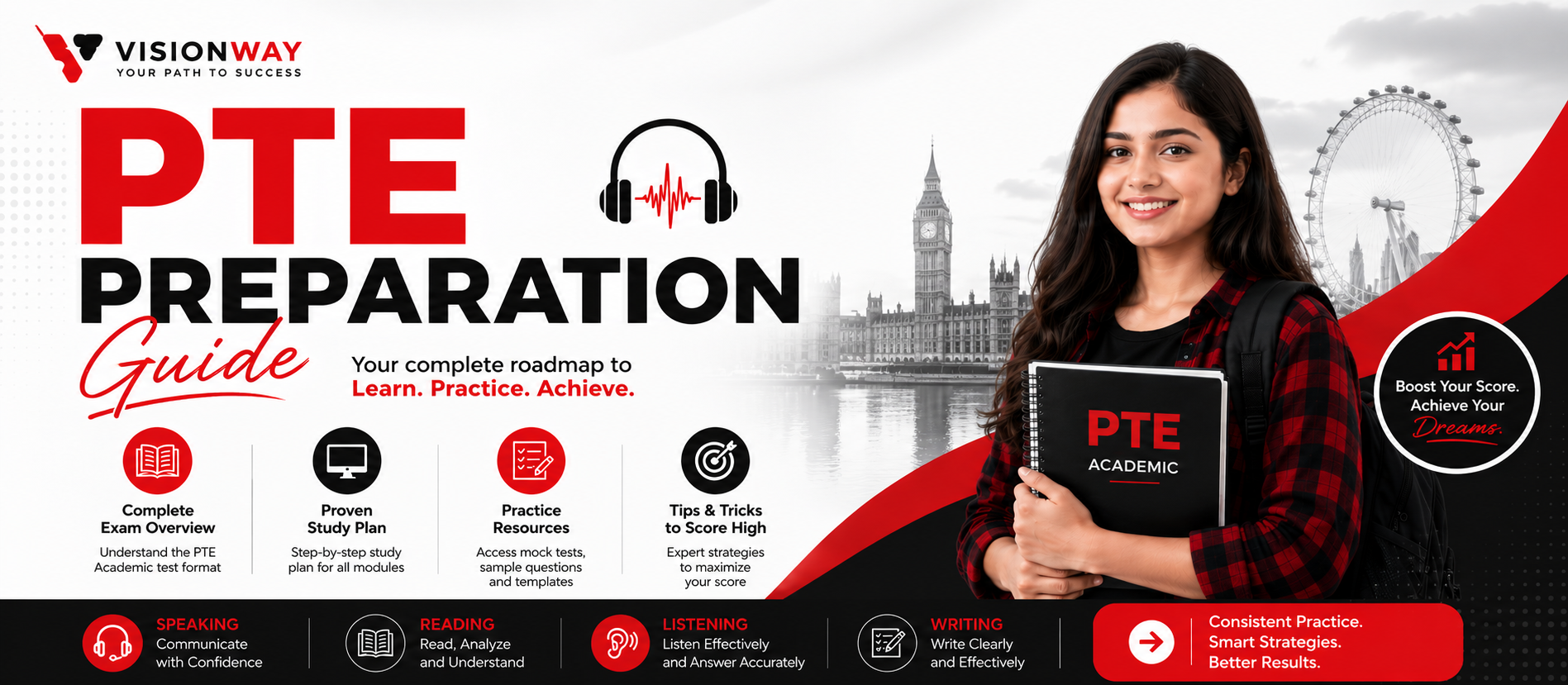
PTE Preparation Guide

Introduction

The Pearson Test of English (PTE Academic) is one of the most widely accepted English language proficiency tests for students planning to study abroad. Accepted by thousands of universities and immigration authorities worldwide, PTE is a computer-based exam designed to assess your speaking, writing, reading, and listening skills.

Whether you’re applying to universities in Australia, Canada, the UK, New Zealand, Ireland, or Europe, a strong PTE score can improve your chances of admission and simplify your visa process.

This comprehensive guide covers everything you need to know about preparing for the PTE exam, including the test format, scoring system, study plan, recommended resources, and practical tips to help you achieve your target score.


What is PTE Academic?

PTE Academic is an English language proficiency test conducted by Pearson. Unlike traditional paper-based exams, PTE is fully computer-based and uses AI-powered scoring to evaluate candidates objectively.

Why Choose PTE?

  • Accepted by 3,500+ institutions worldwide
  • Fast results, usually within 48 hours
  • AI-based scoring ensures fairness
  • Flexible exam dates throughout the year
  • Approved for student visa applications in many countries

Countries Accepting PTE

PTE scores are accepted by universities and institutions in:

  • Canada
  • Australia
  • United Kingdom
  • New Zealand
  • Ireland
  • Germany
  • USA
  • Singapore
  • Europe

Always verify the latest score requirements with your chosen university.


PTE Exam Format

The PTE Academic exam lasts approximately 2 hours and evaluates four key English language skills.

SectionDurationSkills Assessed
Speaking & Writing54–67 MinutesSpeaking, pronunciation, writing
Reading29–30 MinutesReading comprehension
Listening30–43 MinutesListening and note-taking

PTE Scoring System

PTE scores range from 10 to 90.

ScoreEnglish Proficiency
85–90Excellent
76–84Very Good
59–75Good
43–58Competent
30–42Basic

Most universities require scores between 58 and 79, depending on the course and institution.


Step-by-Step PTE Preparation Strategy

Step 1: Understand the Exam Pattern

Before you begin preparing, familiarize yourself with:

  • Exam structure
  • Question types
  • Time limits
  • Scoring methodology

Understanding the format helps reduce exam stress and improves confidence.


Step 2: Evaluate Your Current English Skills

Take a mock test to identify your strengths and areas for improvement.

Assess:

  • Grammar
  • Vocabulary
  • Pronunciation
  • Reading Speed
  • Writing Ability
  • Listening Skills

Step 3: Set Your Target Score

Different universities have different score requirements.

Examples:

  • Diploma Programs: 50–58
  • Bachelor’s Degree: 58–65
  • Master’s Degree: 65–79
  • Competitive Universities: 79+

Section-Wise Preparation Guide

Speaking

The Speaking section evaluates pronunciation, fluency, and confidence.

Preparation Tips

  • Practice reading aloud every day.
  • Improve pronunciation.
  • Record your voice and analyze mistakes.
  • Speak clearly and naturally.
  • Avoid unnecessary pauses.

Writing

Writing assesses grammar, vocabulary, and sentence structure.

Preparation Tips

  • Practice essay writing.
  • Learn essay templates.
  • Improve grammar.
  • Expand your vocabulary.
  • Focus on coherence and structure.

Reading

The Reading section measures your ability to understand academic texts.

Preparation Tips

  • Read newspapers and journals.
  • Learn skimming techniques.
  • Improve reading speed.
  • Practice vocabulary daily.

Listening

Listening evaluates your understanding of spoken English.

Preparation Tips

  • Listen to English podcasts.
  • Watch English news channels.
  • Practice note-taking.
  • Improve concentration.

Best Books for PTE Preparation

Recommended study materials include:

  • Official PTE Academic Guide
  • Pearson Practice Tests
  • Expert PTE Academic Coursebook
  • PTE Academic Practice Tests Plus
  • Official Scored Practice Tests

These resources include authentic practice questions, answer explanations, and exam strategies.


Best Online Resources

Useful online preparation resources include:

  • Official Pearson practice platform
  • Sample mock tests
  • Vocabulary builders
  • Grammar exercises
  • Speaking practice recordings
  • Essay writing samples

30-Day PTE Study Plan

Week 1

  • Understand exam format
  • Improve grammar
  • Build vocabulary
  • Speaking practice

Week 2

  • Reading exercises
  • Listening practice
  • Essay writing
  • Mock test

Week 3

  • Full-length practice tests
  • Speaking fluency
  • Error analysis

Week 4

  • Daily mock exams
  • Time management
  • Final revision
  • Confidence building

Common Mistakes to Avoid

Many students lose marks because they:

  • Ignore pronunciation practice
  • Memorize essay templates without understanding
  • Skip mock tests
  • Ignore grammar
  • Poor time management
  • Limited vocabulary
  • Do not review mistakes

Tips to Improve Your PTE Score

  • Practice every day.
  • Use official study materials.
  • Learn academic vocabulary.
  • Focus on pronunciation.
  • Take weekly mock tests.
  • Review every mistake carefully.
  • Maintain consistency.

How Long Should You Prepare?

Current LevelRecommended Preparation
Beginner3–4 Months
Intermediate6–8 Weeks
Advanced3–4 Weeks

The ideal preparation time depends on your current English proficiency and target score.


Frequently Asked Questions

Is PTE easier than IELTS?

Neither exam is easier. The better choice depends on your strengths. Students who are comfortable with computer-based tests often prefer PTE.

How many times can I take the PTE exam?

There is no limit to the number of attempts. However, you should prepare thoroughly before retaking the exam.

What is a good PTE score?

A score between 65 and 79 is generally accepted by most universities. Competitive institutions may require 79+.

Can I prepare for PTE at home?

Yes. Many students successfully prepare using official books, online mock tests, and regular practice.

How long does it take to receive PTE results?

Most candidates receive their results within 48 hours, although processing times may vary.


Final Preparation Checklist

Before your exam, ensure you have:

  • Completed multiple mock tests
  • Practiced all question types
  • Improved vocabulary
  • Reviewed grammar
  • Practiced speaking regularly
  • Managed time effectively
  • Checked your exam documents

Related Resources

Enhance your preparation with these guides:

  • Complete IELTS Preparation Guide
  • TOEFL Preparation Guide
  • GRE Preparation Guide
  • GMAT Preparation Guide
  • Best PTE Preparation Books
  • SOP Writing Guide
  • LOR Writing Guide

Need Expert Guidance?

Preparing for the PTE exam is easier with expert support. At VisionWay, our experienced study abroad counsellors help students choose the right preparation strategy, understand university requirements, and plan their study abroad journey with confidence.

Book Your Free Counselling Session Today

Get personalized advice on PTE preparation, university admissions, scholarships, and student visas.


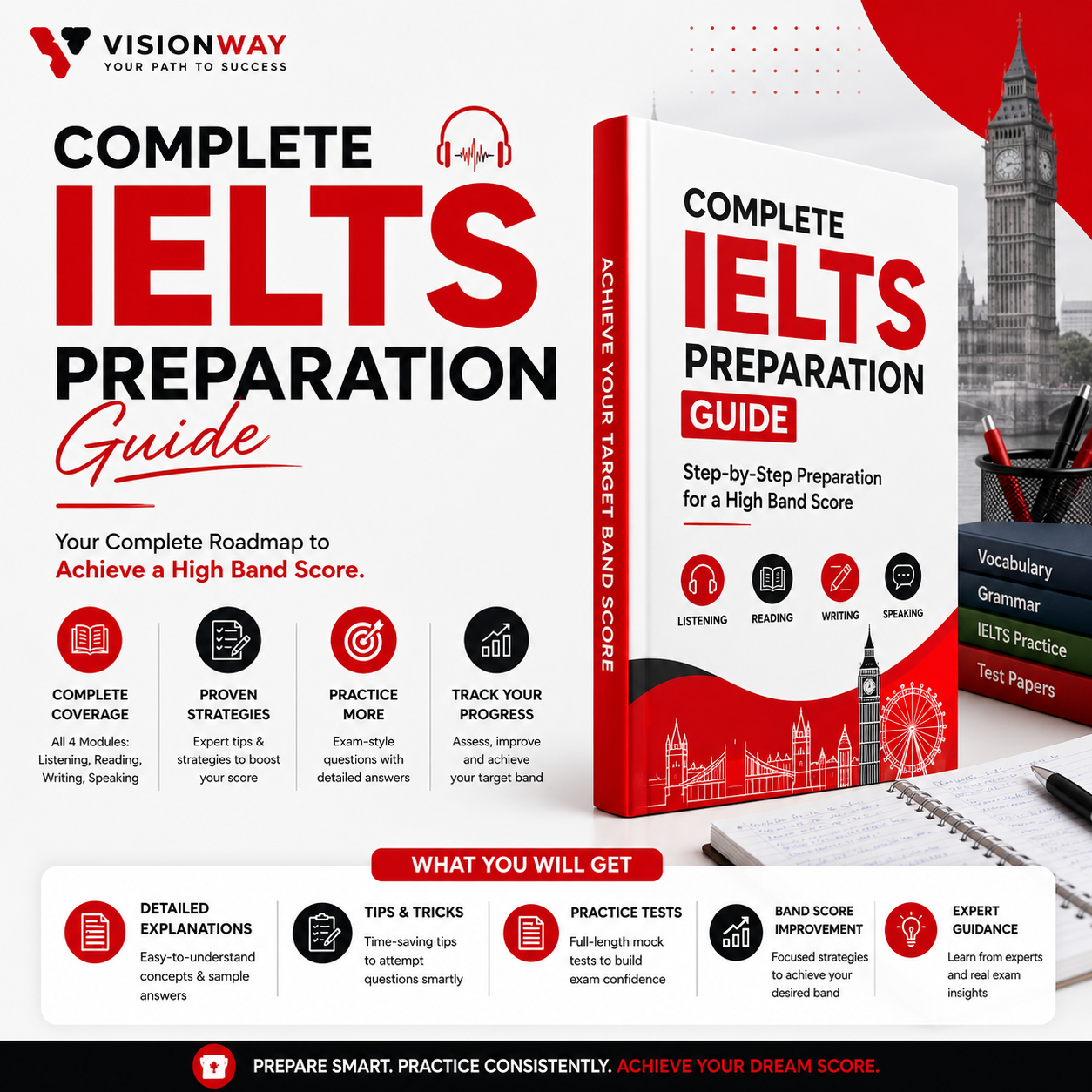
Complete IELTS Preparation Guide

Step-by-Step IELTS Preparation Plan

Step 1: Understand the Test Format

Before starting your preparation, familiarize yourself with:

  • Question types
  • Time limits
  • Marking criteria
  • Band descriptors

Understanding the format helps reduce exam anxiety and improves confidence.


Step 2: Assess Your Current English Level

Take a diagnostic test to identify your strengths and weaknesses.

Evaluate:

  • Listening
  • Reading
  • Writing
  • Speaking
  • Vocabulary
  • Grammar

Step 3: Set Your Target Band Score

Different universities have different IELTS requirements.

For example:

  • Diploma Programs: 6.0
  • Bachelor’s Degree: 6.5
  • Master’s Degree: 6.5–7.0
  • Competitive Universities: 7.5+

Having a clear goal helps you create a focused study plan.


Section-wise Preparation Guide

Listening Preparation

The Listening section contains four recordings with increasing difficulty.

Tips

  • Listen to English podcasts daily.
  • Watch English news channels.
  • Practice note-taking.
  • Learn common spelling patterns.
  • Improve concentration.

Recommended practice:

  • Cambridge IELTS Books
  • BBC Learning English
  • IELTS Listening Practice Tests

Reading Preparation

The Reading section tests your ability to understand academic texts.

Tips

  • Improve reading speed.
  • Learn skimming techniques.
  • Practice scanning for keywords.
  • Build vocabulary.
  • Read newspapers and journals regularly.

Recommended sources:

  • National Geographic
  • BBC News
  • The Guardian

Writing Preparation

The Writing section includes:

Task 1

Describe charts, graphs, maps, or diagrams.

Task 2

Write an essay based on a given topic.

Writing Tips

  • Plan before writing.
  • Use formal vocabulary.
  • Write clear paragraphs.
  • Avoid grammatical errors.
  • Review your work before submission.

Speaking Preparation

The Speaking test is conducted face-to-face with an examiner.

It consists of:

  • Introduction
  • Cue Card
  • Discussion

Speaking Tips

  • Speak confidently.
  • Avoid memorized answers.
  • Maintain eye contact.
  • Expand your responses.
  • Practice speaking daily.

Best IELTS Preparation Books

Recommended resources include:

  • Cambridge IELTS Series
  • The Official Cambridge Guide to IELTS
  • IELTS Trainer
  • Collins IELTS Skills
  • Barron’s IELTS Superpack

These books provide authentic practice questions, sample answers, and exam strategies.


Best Free IELTS Resources

Students can improve their preparation using:

  • Official IELTS Sample Tests
  • British Council Practice Materials
  • IDP IELTS Resources
  • BBC Learning English
  • YouTube IELTS Lessons
  • Vocabulary Lists
  • Grammar Exercises

30-Day IELTS Study Plan

Week 1

  • Understand exam format
  • Learn grammar basics
  • Build vocabulary
  • Practice Listening

Week 2

  • Reading practice
  • Listening mock tests
  • Writing Task 1
  • Speaking practice

Week 3

  • Writing Task 2
  • Full Reading Tests
  • Speaking Mock Interviews

Week 4

  • Full-Length Mock Tests
  • Error Analysis
  • Time Management Practice
  • Final Revision

Common IELTS Preparation Mistakes

Avoid these mistakes:

  • Ignoring grammar fundamentals
  • Not practicing writing regularly
  • Memorizing speaking answers
  • Skipping mock tests
  • Poor time management
  • Limited vocabulary
  • Not reviewing mistakes

Time Management Tips

During the exam:

  • Don’t spend too much time on one question.
  • Read instructions carefully.
  • Keep five minutes for revision.
  • Practice under timed conditions.

How Long Does IELTS Preparation Take?

Current English LevelRecommended Preparation Time
Beginner3–6 Months
Intermediate2–3 Months
Advanced4–8 Weeks

Consistency is more important than studying for long hours occasionally.


Frequently Asked Questions

Is IELTS difficult?

IELTS is manageable with consistent preparation, regular practice, and the right study materials.

Can I prepare for IELTS at home?

Yes. Many students successfully prepare at home using official books, online resources, and mock tests.

What is a good IELTS score?

A Band 6.5–7.0 is accepted by most universities, while top-ranked institutions may require 7.5 or higher.

How many hours should I study daily?

Studying 2–3 hours daily with focused practice is sufficient for most students.

Which section is the hardest?

Many students find Writing challenging because it requires strong grammar, vocabulary, and structured arguments.

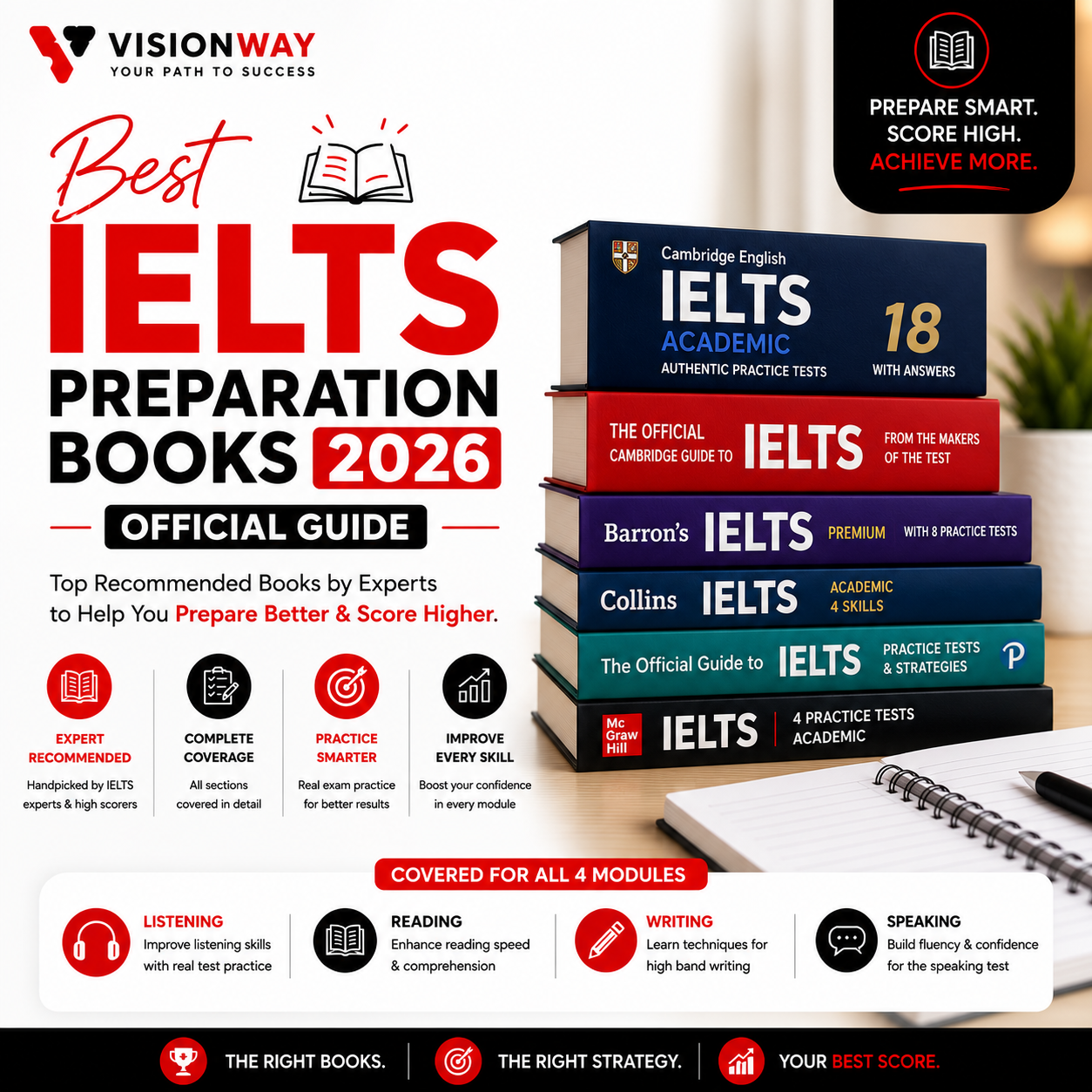
Best IELTS Preparation Books 2024: Official Guide

Discover the best IELTS preparation books for 2026. Explore official Cambridge IELTS books, vocabulary guides, practice tests, and expert recommendations to help you achieve Band 7, 8, or 9.


Best IELTS Preparation Books

Preparing for the IELTS exam is one of the most important steps for students planning to study abroad. Whether you’re applying to universities in Canada, the UK, Australia, New Zealand, or Ireland, a strong IELTS score can significantly improve your admission and visa prospects.

Choosing the right preparation books helps you understand the exam format, improve your English skills, and build confidence through regular practice. This guide covers the best IELTS books for beginners and advanced learners, along with study tips and free resources.


Why Choosing the Right IELTS Book Matters

A good IELTS preparation book can help you:

  • Understand the complete IELTS exam format
  • Improve Listening, Reading, Writing, and Speaking skills
  • Learn proven strategies for each section
  • Practice with real exam-style questions
  • Build confidence before test day

Top IELTS Preparation Books

1. Cambridge IELTS Series (Highly Recommended)

Best For: Authentic Practice Tests

The Cambridge IELTS series is the most trusted resource because it contains real IELTS exam papers from previous years. Each book includes four complete practice tests along with answer keys and audio files.

Key Features

  • Real IELTS exam questions
  • Listening audio
  • Writing sample answers
  • Answer explanations
  • Suitable for Academic and General Training

Recommended for: Band 6.5–9.0


2. The Official Cambridge Guide to IELTS

Best For: Beginners

This guide explains the IELTS format in detail and provides step-by-step strategies for every section. It also includes eight practice tests and helpful study tips.

Highlights

  • Easy-to-understand explanations
  • Practice exercises
  • Grammar improvement
  • Vocabulary building

3. Barron’s IELTS Superpack

A comprehensive package that includes:

  • IELTS textbook
  • Practice tests
  • Audio CDs
  • Vocabulary exercises
  • Writing samples

Suitable for students targeting Band 7 or higher.


4. Collins IELTS Series

The Collins series offers separate books for:

  • Listening
  • Reading
  • Writing
  • Speaking

These books are ideal if you want to improve one specific skill.


5. IELTS Trainer

This book contains six complete practice tests with expert guidance. The first two tests provide detailed explanations, while the remaining tests simulate the real exam.


6. IELTS Vocabulary Booster

Vocabulary plays a major role in achieving a high band score. A dedicated vocabulary book helps you learn:

  • Academic words
  • Synonyms
  • Collocations
  • Common IELTS expressions

Best Books According to Your Target Band

Target ScoreRecommended Books
Band 5–6Official Cambridge Guide + Collins
Band 6–7Cambridge IELTS Series + IELTS Trainer
Band 7–8Cambridge + Barron’s + Vocabulary Booster
Band 8–9Cambridge Latest Books + Mock Tests + Advanced Vocabulary

30-Day IELTS Study Plan

Week 1

  • Understand the IELTS format
  • Learn grammar basics
  • Build vocabulary

Week 2

  • Practice Listening and Reading
  • Solve one mock test

Week 3

  • Focus on Writing Task 1 & 2
  • Improve Speaking skills

Week 4

  • Take full-length mock tests
  • Analyze mistakes
  • Revise weak areas

Common Mistakes Students Make

  • Choosing outdated study materials
  • Ignoring vocabulary building
  • Not practicing writing regularly
  • Taking too many mock tests without reviewing mistakes
  • Skipping speaking practice

Free IELTS Resources

In addition to books, students should practice using:

  • Official IELTS sample tests
  • Vocabulary lists
  • Writing task samples
  • Speaking cue cards
  • Grammar exercises

Frequently Asked Questions

Which IELTS book is best for beginners?

The Official Cambridge Guide to IELTS is one of the best books for beginners because it explains the exam format in a simple and structured way.

Which IELTS book contains real exam questions?

The Cambridge IELTS Series includes authentic past exam papers and is considered the most reliable practice material.

Can I prepare for IELTS using only one book?

One good book can help, but combining official practice tests with vocabulary and grammar resources gives better results.

How many months are required for IELTS preparation?

Most students need 6–12 weeks of consistent study, depending on their current English proficiency and target band score.

Which IELTS book is best for Band 8?

The Cambridge IELTS Series, IELTS Trainer, and Barron’s IELTS Superpack are excellent choices for students aiming for Band 8 or above.


Related Resources

  • Best PTE Preparation Books
  • Best TOEFL Preparation Books
  • SOP Writing Guide
  • Study in Canada Guide
  • Study in UK Guide

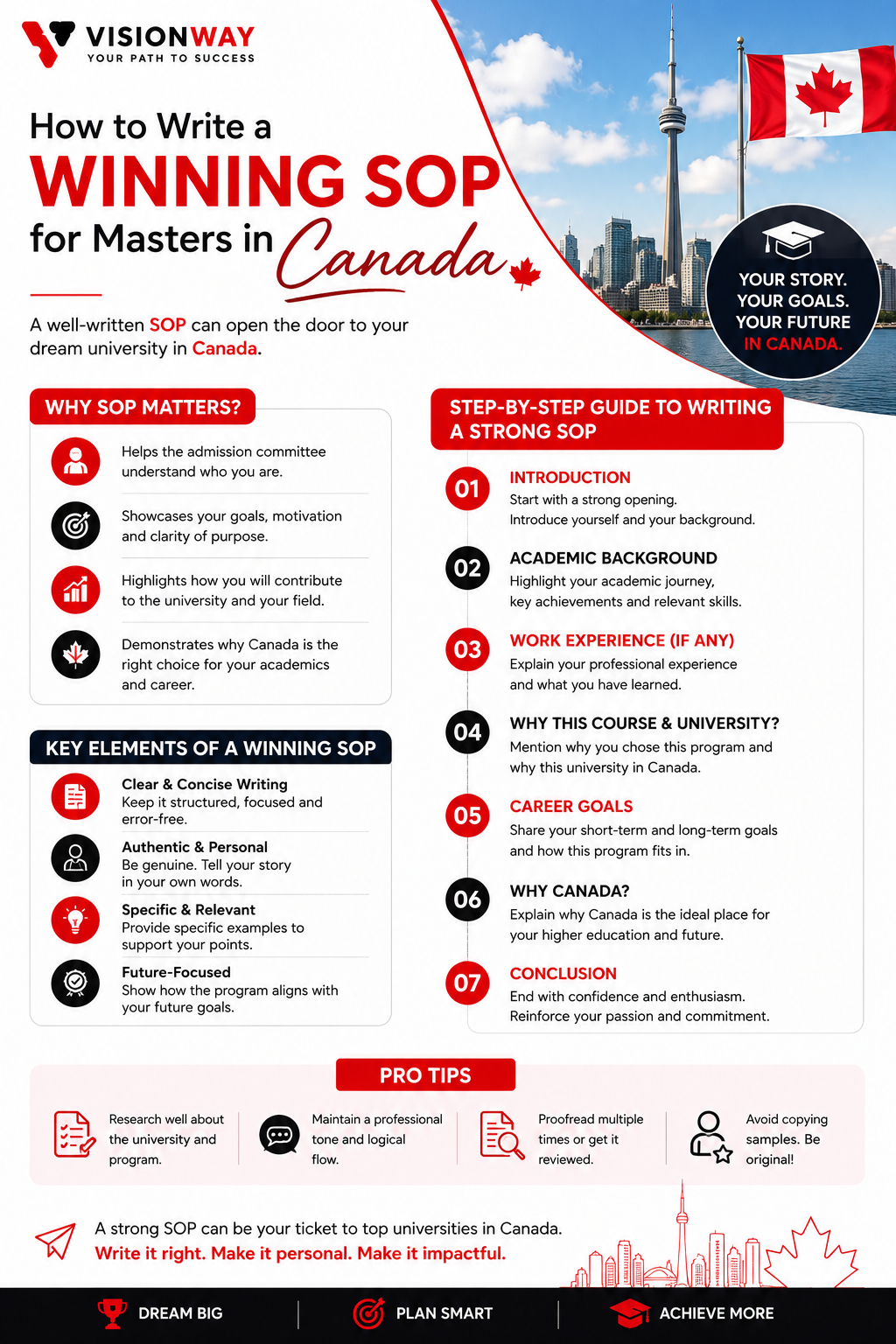
How to Write a Winning SOP for Masters in Canada

Your Statement of Purpose (SOP) is your chance to talk directly to the admissions committee. For Canadian universities, a well-structured, honest SOP can often outweigh slightly lower academic scores.

The Perfect SOP Structure

A Canadian Master’s SOP should follow a logical narrative arc:

  1. The Hook: Start with an engaging story or realization that sparked your interest in the field.
  2. Academic Background: Briefly summarize your undergrad achievements without repeating your resume.
  3. Professional Experience: How has your work experience prepared you for this advanced degree?
  4. Why This University: Mention specific professors, research labs, or curriculum features.
  5. Future Goals: How will this degree help you achieve your 5-year career plan?

Common Mistakes to Avoid

Avoid these fatal errors:

  • Plagiarism: Canadian universities use advanced software. Never copy templates.
  • Being Vague: Saying “I want to study in Canada because it has great education” is a waste of words. Be specific.
  • Grammar Errors: An SOP with poor English is an instant rejection.