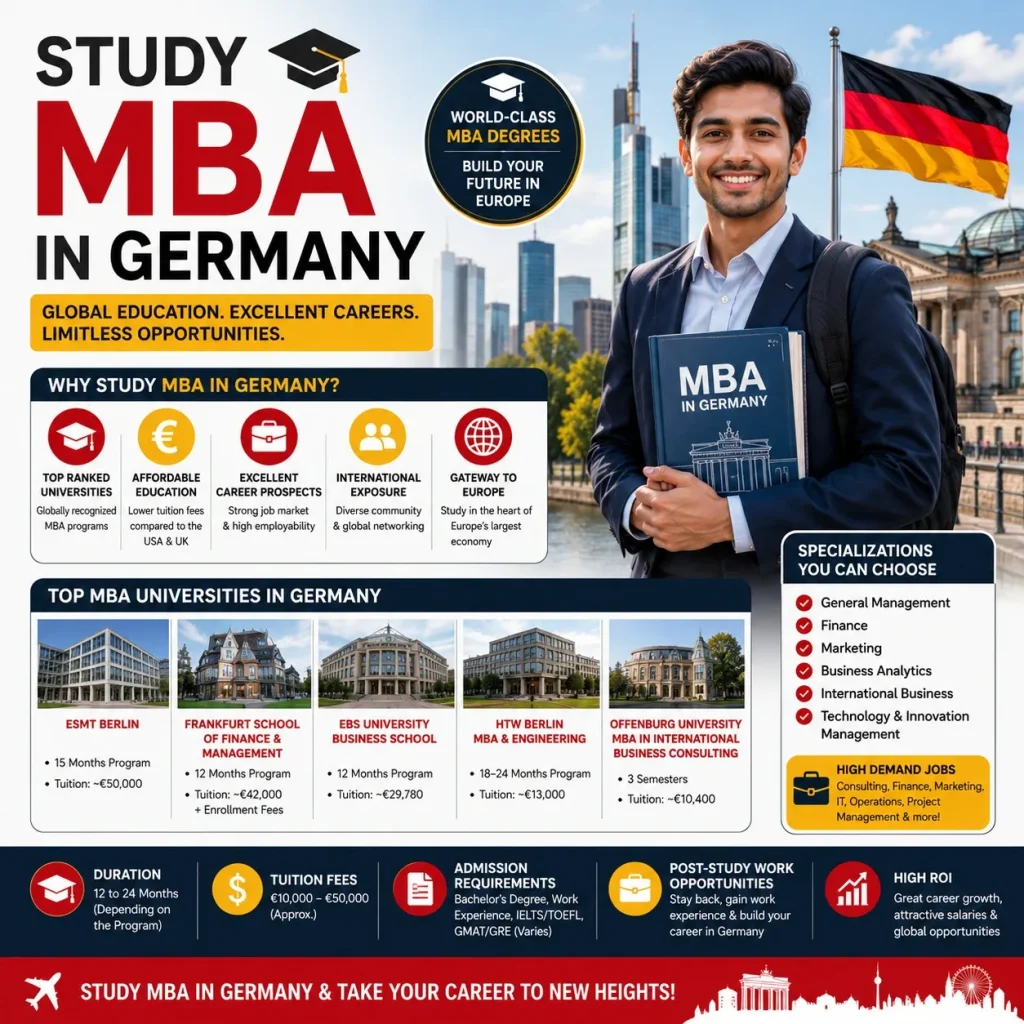
Study MBA in Germany: Top Universities, Costs, Career Opportunities & Admission Guide 2026
One of the most alluring locations for individuals looking to earn an internationally recognized MBA degree is now Germany. For prospective business leaders, Germany offers outstanding value because of its robust economy, multinational firms, reasonably priced education, and great post-study employment prospects.
An MBA in Germany can lead to chances throughout Europe and beyond, whether your goal is to grow professionally, change industries, or obtain experience in international management.
Why Go to Germany to Get an MBA?
BMW, Mercedes-Benz, Siemens, SAP, Bosch, Volkswagen, Deutsche Bank, and many other global corporations are based in Germany, which has the largest economy in Europe.
The following are some major advantages of pursuing an MBA in Germany:
MBA degrees with international recognition
Good job prospects
Reasonably priced tuition in comparison to the UK and USA
Access to the biggest economy in Europe
Great prospects for post-study employment
High salaries after graduation
Exposure to international business
Germany is a great place for graduates who are focused on their careers because it actively draws qualified professionals and international students.
Germany’s Top MBA Schools
Berlin’s ESMT
One of the most prominent business schools in Germany is ESMT Berlin.
Highlights:
Curriculum for international MBA programs
Robust business alliances
situated among Berlin’s startup community
Put leadership and creativity first.
Program Length:
Fifteen Months
Tuition:
The entire program will cost about €50,000.
Frankfurt School of Finance & Management
Located in Germany’s financial capital, Frankfurt School is highly regarded for finance and business education.
Highlights:
Strong expertise in finance
International business network
Focus on leadership development
Program Length:
Twelve Months
Tuition:
plus enrollment fees, almost €42,000.
Business School at EBS University
one of the top private business schools in Germany.
Highlights:
Education in practical business
Strong industry ties and international professors
Program Length:
Twelve months of full-time work
Tuition:
A total of about €29,780.
MBA & Engineering at HTW Berlin
Perfect for professionals looking for technical and managerial skills.
Highlights:
Focus on engineering and management
Global context
Curriculum focused on industry
Tuition:
The overall cost of the program was about €13,000.
MBA in International Business Consulting at Offenburg University
One of the more reasonably priced MBA programs available to foreign students.
Highlights:
Curriculum with a consulting focus
Strong employability outcomes
English-taught program
Tuition:
Over the course of three semesters, about €10,400.
German MBA Specializations
There are numerous specializations available to students:
Overall Administration
Gain expertise in strategy, leadership, and business decision-making.
Money
Perfect for jobs in consulting, financial management, and investment banking.
Marketing
Pay attention to international markets, customer behavior, branding, and digital marketing.
Analytics for Business
integrates data-driven decision-making with company strategy.
Global Commerce
equips students for leadership positions in international business.
Innovation and Technology Management
popular among experts in emerging technologies and digital transformation.
The price of an MBA program in Germany
The price varies according on the organization.
Approximate Cost of Expense
Tuition Fees €10,000 – €50,000
Monthly Living Expenses: €900 to €1,300
Health insurance costs between €120 and €150 a month.
Other Expenses: €100 to €300 a month
Germany frequently offers a more economical return on investment as compared to MBA programs in the USA, UK, or Australia.
Requirements for Admission
The majority of MBA programs in Germany demand:
English competence (TOEFL or IELTS) and a bachelor’s degree from an accredited university
Updated Resume/CV
Statement of Purpose (SOP)
Recommendation letters (LORs)
GRE or GMAT (for certain universities)
Work experience that is pertinent
Candidates with at least two to three years of professional experience are preferred by several prestigious MBA programs.
Career Prospects in Germany Following an MBA
For MBA graduates, the German labor market provides great prospects.
Among the popular industries are:
Finance, Technology, Manufacturing, Automotive, Healthcare, Supply Chain, and Logistics
Typical employment roles consist of:
Project manager, product manager, financial analyst, marketing manager, operations manager, business consultant, and business development manager
International graduates have great career possibilities due to Germany’s high need for qualified experts.
Post-Study Employment Possibilities
International graduates can stay in Germany to look for work after earning an MBA.
Advantages consist of:
Possibility of obtaining work experience in Germany
Access to Europe’s largest job market
A route to long-term residence
High demand for talent from abroad
Qualified professionals and graduates from all over the world continue to be drawn to Germany.
Why Opt for Germany Instead of Other MBA Locations?
Germany vs USA
Reduced tuition fees
Reduced living costs
Good employment prospects
Germany versus the UK
Increased affordability
Growing economy
Outstanding industrial sector
Canada versus Germany
Reduced total costs of education
robust manufacturing and engineering sectors
Superior business education
In conclusion
An MBA in Germany provides an exceptional blend of career advancement, affordability, international exposure, and academic brilliance. You will have access to top-notch education and one of the best employment markets in Europe whether you select Offenburg University, EBS University, HTW Berlin, Frankfurt School, or ESMT Berlin.
Our knowledgeable advisors can assist you in selecting the best university, preparing your application, obtaining scholarships, and navigating the student visa application procedure if you intend to pursue an MBA in Germany.