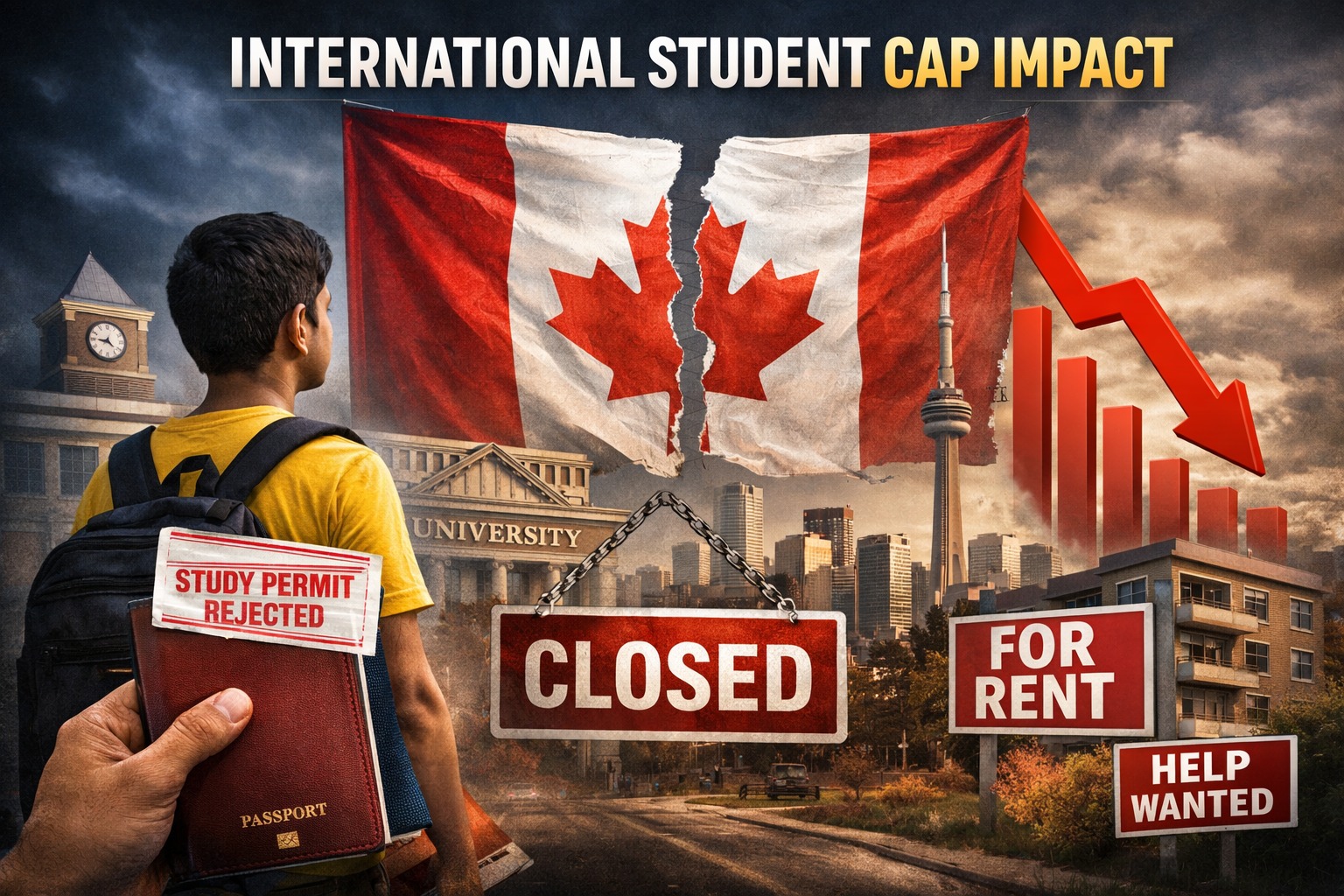
Introduction: Canada's Student Appeal Faces New Reality
Canada has been one of the most sought-after destinations for foreign students in recent years, especially those from India. The nation has gained a reputation as a student-friendly nation thanks to its internationally recognised universities, post-study employment opportunities, and path to permanent residency.
Recent events, however, have altered the story. According to a government assessment, Canada's international student cap has far more of an impact than the government had predicted. Students, educational institutions, and immigration stakeholders are all quite concerned about this.
What Is the International Student Cap in Canada?
The Canadian government imposed a cap on visas for foreign students from the beginning of 2024. The action was intended to allay mounting worries about housing shortages, public services under pressure, and rapid population increase in key provinces.
Stabilising infrastructure while preserving the standard of living for locals and new students was the aim. The cap was initially offered as a controlled, short-term solution. However, the results of a recent audit indicate that its practical effects have been far more profound than anticipated.
- 🏠 Lack of housing
- 🏥 Public services under pressure
- 📈 Rapid population growth in key provinces
Important Conclusions from the Government Audit
Canada's overseas education industry is now changing as a result of the audit's surprising findings. These revelations are shaping how international students, institutions, and industry stakeholders approach the Canadian education market.
Finding 1: A Sharp Decline in Applications for Study Permits
A discernible decline in new applications has been one of the most immediate effects. Students are now reevaluating their options after previously viewing Canada as a "safe option."
As a result, interest is rising in nations like Australia, the UK, and even new travel locations in Europe. The competition is shifting to other countries that offer clearer pathways for international students.
- 📉 Decreased study permit applications
- 🌍 Students exploring Australia, UK, Europe
- ⚖️ Shifting from "safe option" mentality
Finding 2: Financial Stress on Universities and Colleges
International student fees are a major source of funding for many Canadian institutions, particularly smaller ones. The cap has resulted in significant financial challenges:
Currently, several institutions are finding it difficult to continue operating on the same scale. Program sustainability and institutional viability are now real concerns.
- 💰 Diminished sources of income
- 📊 Financial limitations and revenue loss
- ❌ Possible program reductions
Finding 3: Increased Regional Inequality
The audit also showed that not every province has been equally impacted by the cap. Stricter restrictions have been implemented in popular areas like British Columbia and Ontario, but there is still opportunity for expansion in other provinces.
Agents and candidates are confused as a result of this unequal distribution. The inconsistency creates uncertainty about which provinces are viable for international students.
- 🚫 Stricter caps in BC and Ontario
- ✅ More flexibility in other provinces
- ❓ Inconsistent regional policies
Finding 4: Effect on the Local Economy
The Canadian economy benefits greatly from the contributions of international students, not only through tuition but also through other economic channels:
Local businesses in student-heavy cities are beginning to feel the slowdown as fewer students enter the nation. This has ripple effects across multiple sectors.
- 🏠 Rentals and housing market
- 💼 Part-time work opportunities
- 🛒 Everyday living costs and consumer spending
- 📉 Business revenue declining
Reasons for Underestimating the Impact
What went wrong with the government's initial projections? Policymakers may have misjudged the interconnectedness of the foreign student environment.
The problem is that universities are not the only institutions affected by a cap on student enrolment. The entire ecosystem—from real estate markets to employment sectors to regional development plans—is interconnected.
Furthermore, institutions and students have limited time to adjust due to the abrupt nature of the policy announcement.
- 🔗 Underestimated interconnectedness
- 📋 Impact extends beyond universities
- ⏰ Limited adjustment time for all stakeholders
What This Signifies for International Students
This development does not imply the door is closed if you intend to study in Canada in 2026 or later, but it does indicate that the procedure has gotten more strategic and competitive.
Success now requires careful planning, informed decisions, and strategic application timing. Here's what you need to remember:
Your Action Plan for Canadian Admissions
If Canada remains on your radar, these strategies will improve your chances in this competitive landscape:
- ✏️ Make an Early Application - Delays could reduce your chances because of limited quotas
- ✏️ Carefully Choose Institutions - Not every college is affected in the same way. Research is more important than ever
- ✏️ Analyse Other Provinces - Lesser-known provinces might have better long-term prospects and acceptance rates
- ✏️ Enhance Your Profile - Financial documents, educational background, and a strong SOP can make a significant difference
A Shift in Global International Student Trends
Canada's policy is already making a difference on a global scale. Students are now expanding their choices by taking into account destinations that offer:
This shift may reshape international education trends in the years to come, creating opportunities in other nations.
- 🎯 Flexible visa requirements
- ⚡ Faster processing times
- 📜 Well-defined post-study work routes
- 🌱 Growth potential and economic stability
Concluding Remarks: More Strategy Required
The goal of Canada's international student cap was to balance growth, but a recent government audit revealed that its effects have been more profound, extensive, and complicated than anticipated.
For international students, this is a signal to make more intelligent plans rather than a setback. Opportunities remain, but the right strategy, timing, and focus are essential for achievement.
The students who succeed will be those who adapt quickly, research thoroughly, and seek expert guidance in navigating these new regulations.
Need Expert Guidance on Canada or Alternative Destinations?
At VisionWay, we help students confidently and clearly understand the evolving immigration landscape. Regardless of how regulations shift, our 17+ years of experience and thousands of successful cases ensure your study abroad plans stay on track.
Whether Canada remains your goal or you're exploring alternatives, we have the expertise to guide you.
- 📞 Call us at 93624-93624
- 📍 Visit your nearest VisionWay branch
- 📩 Book your complimentary counseling session today