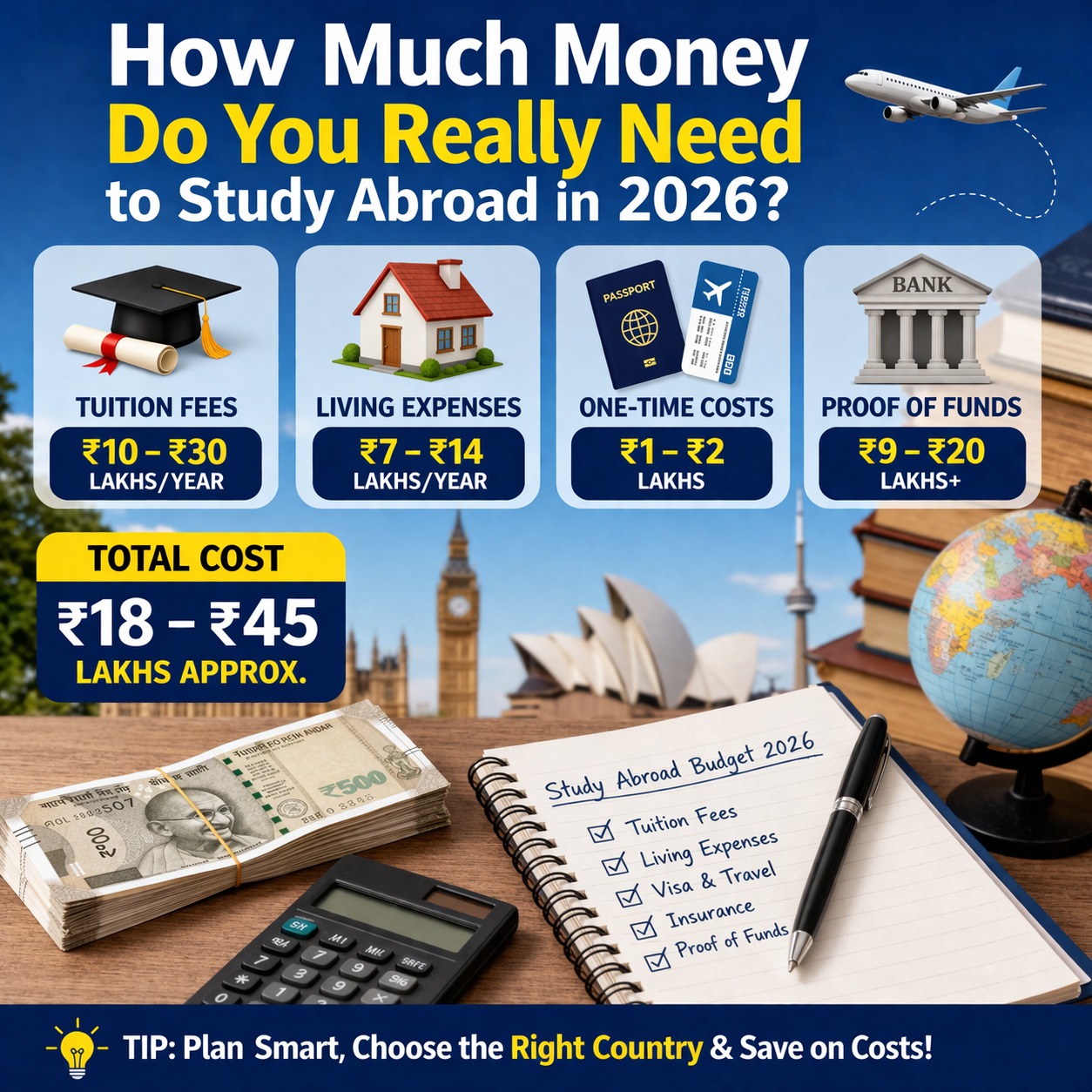
The Big Question Every Student Asks: "Kitna Paisa Lagega?"
Do you intend to study overseas in 2026? Every student's (and parent's) first question is the same: How much money will you actually need?
The honest answer? It depends. The country, course, lifestyle, and city you choose will determine your total costs. But don't worry—this comprehensive guide breaks down everything in a realistic, understandable, and practical way so you can make smart financial plans.
Let's calculate your actual budget and discover ways to make studying abroad affordable and achievable.
- 💰 Total cost ranges from ₹18 to ₹45+ lakhs annually
- 🌍 Varies significantly by country and lifestyle
- 📊 Tuition, living costs, and one-time expenses differ
- ✅ Part-time work can offset 30-50% of costs
- 🎯 Smart choices can reduce expenses dramatically
- 💡 See what VisionWay students typically budget
1. The Largest Expense: Tuition Fees
Tuition fees are typically the biggest expense when studying abroad. University costs vary significantly depending on the country, institution type (public/private), and program level (undergraduate/postgraduate).
Here's what you can expect to pay for tuition across major study destinations in 2026. These figures are based on current university fee structures and currency conversion.
- 🇨🇦 Canada: ₹10 to ₹22 lakhs per year
- → Undergraduate: ₹10-18 lakhs
- → Postgraduate: ₹12-22 lakhs
- → Professional programs (MBA): ₹18-28 lakhs
- 🇬🇧 United Kingdom: ₹12 to ₹25 lakhs per year
- → Undergraduate: ₹15-22 lakhs
- → Postgraduate: ₹12-25 lakhs
- → Russell Group Universities: Higher fees
- 🇦🇺 Australia: ₹15 to ₹30 lakhs per year
- → Engineering/IT: ₹18-30 lakhs
- → Business/Management: ₹15-28 lakhs
- → Healthcare: ₹20-32 lakhs
- 🇩🇪 Germany: ₹0 to ₹3 lakhs per year
- → Most public universities: FREE or minimal fees
- → Private universities: ₹2-5 lakhs
- → 👉 Germany is the MOST AFFORDABLE option
- 🇮🇪 Ireland: ₹10 to ₹20 lakhs per year
- → EU rate: Free (for EU citizens only)
- → International students: ₹10-20 lakhs
- → Tech/Business: ₹15-20 lakhs
- 🇫🇮 Finland: ₹8 to ₹18 lakhs per year
- → Public universities: Some FREE programs
- → Engineering/Tech: ₹12-18 lakhs
- → Business/MBA: ₹18-25 lakhs
- 👉 Key Insight: Australia and UK are more expensive; Germany offers the best value
2. Living Expenses: The Monthly Reality Check
Living expenses vary dramatically based on your city, country, and lifestyle choices. A student in London will spend significantly more than one in Berlin. Your housing, food, transportation, and entertainment choices directly impact your monthly budget.
Here's a realistic breakdown of what students typically spend monthly across different study destinations.
- 🏠 Accommodation (Monthly)
- → Major cities (London, Sydney, Toronto): ₹40-80K
- → Medium cities (Berlin, Dublin): ₹25-50K
- → Smaller cities: ₹20-40K
- → University accommodation: ₹20-35K
- 🍽️ Food & Groceries (Monthly)
- → Budget cooking at home: ₹10-15K
- → Mixed (some eating out): ₹15-25K
- → Frequent dining out: ₹25-40K
- → Tip: Cooking saves 40% compared to eating out
- 🚌 Transportation (Monthly)
- → Student passes (buses/metro): ₹3-8K
- → Without passes (taxis/Uber): ₹8-15K
- → Walking/cycling areas: ₹0-3K
- → Most cities offer student discounts (40-50% off)
- 📱 Utilities & Essentials (Monthly)
- → Internet: ₹1-3K
- → Electricity/Water: ₹2-4K
- → Mobile phone: ₹1.5-3K
- → Laundry & cleaning: ₹2-5K
- 🎉 Entertainment & Miscellaneous (Monthly)
- → Minimal (movie once/week): ₹5-10K
- → Moderate (social activities): ₹10-15K
- → Active lifestyle: ₹15-25K
- 📊 TOTAL MONTHLY REALITY CHECK:
- → Budget student: ₹50-75K/month
- → Average student: ₹75-110K/month
- → Premium lifestyle: ₹110-150K/month
- 💡 Annual Living Cost: ₹6-18 lakhs (depending on lifestyle and location)
3. One-Time Expenses (A Major Component Students Miss)
Students often underestimate one-time expenses, which can add up quickly. These are costs you pay before leaving India—they're not recurring annually but are essential for your overseas journey.
Budget for these carefully; they often catch students off guard if not planned in advance.
- ✈️ Visa Processing Fees
- → Canada: ₹8,000-15,000
- → UK: ₹20,000-30,000
- → Australia: ₹15,000-25,000
- → Germany: ₹2,000-5,000
- → Ireland: ₹10,000-15,000
- → Finland: ₹5,000-10,000
- 📝 English Language Tests
- → IELTS: ₹15,000-18,000
- → PTE: ₹12,000-15,000
- → TOEFL: ₹18,000-20,000
- → 💡 Tip: Some universities waive tests for strong academics
- ✈️ International Airfare
- → Economy Class (Round Trip): ₹40,000-1,00,000
- → Off-season (best prices): ₹35,000-60,000
- → Peak season (April/Aug): ₹70,000-1.5 lakhs
- → 💡 Tip: Book 6-8 weeks in advance for better deals
- 🏥 Medical Insurance & Health Checkup
- → Visa medical tests: ₹5,000-10,000
- → First year insurance: ₹15,000-50,000
- → Emergency evacuation cover: ₹2,000-5,000
- → Post-arrival health insurance: ₹20,000-40,000/year
- 📋 Application & Processing Fees
- → University application fees: ₹5,000-15,000 per university
- → Documentation & transcripts: ₹3,000-8,000
- → Credential evaluation: ₹5,000-12,000
- 🎒 Initial Setup & Travel
- → Luggage & baggage: ₹8,000-20,000
- → Initial purchases (laptop, etc): ₹50,000-2,00,000
- → SIM card & local setup: ₹1,000-3,000
- 📊 TOTAL ONE-TIME EXPENSES:
- → Minimum: ₹1-1.5 lakhs
- → Average: ₹1.5-2.5 lakhs
- → Maximum: ₹2.5-4 lakhs
4. Funds Verification: The Money You Need to Show (But Don't Lose)
Most countries require proof that you have sufficient funds to support yourself. This is a critical requirement for visa approval. Important: This is money YOU NEED TO SHOW, but it remains YOUR money—it\'s not spent on processing fees.
Different countries have different minimum fund requirements. Let\'s break them down.
- 🇨🇦 Canada - Financial Proof Required
- → Study Permit: You must prove funds for first year tuition + living
- → Bank balance needed: ₹10-12 lakhs
- → GIC (Guaranteed Investment Certificate): ₹5-10 lakhs additional
- → For family sponsorship: Higher amounts required
- 🇬🇧 UK - No Fixed Minimum Amount
- → Visa: Bank statements for last 28 days
- → Show: ₹9-12 lakhs as proof of funds
- → 2+ years of UK universities are covered
- → Rules are flexible; must align with course costs
- 🇦🇺 Australia - Mandatory Bank Balance
- → Genuine Temporary Entrant (GTE) requirement
- → Proof needed: ₹20-25 lakhs minimum
- → This covers full tuition + living (typically 2 years)
- → Indian students must show substantial funds
- 🇩🇪 Germany - Blocked Account (Sperrkonto)
- → Unique requirement: Freeze ~₹11 lakhs
- → Purpose: Shows you can afford 1 year of study + living
- → This money can be withdrawn monthly (₹80-90K)
- → Safer than other countries (money stays accessible)
- 🇮🇪 Ireland - Proof of Funds
- → Show: ₹12-15 lakhs for first year
- → Bank statements: Last 6 months required
- → Less stringent than Australia
- 🇫🇮 Finland - Modest Requirements
- → Proof: ₹8-10 lakhs minimum
- → Bank statements acceptable
- → Flexible compared to other Nordic countries
- 💡 KEY POINT: This is NOT an additional expense—it's YOUR money you keep
5. Smart Way to Reduce Costs: Part-Time Work While Studying
Here's the game-changer: Most countries allow international students to work part-time, which can significantly offset your living costs and reduce the burden on family finances.
Working part-time while studying is not just allowed—it's encouraged in most countries. Let's see how much you can realistically earn.
- ⏰ Work Permission & Hours Allowed
- → Canada: 20 hours/week during study; full-time during breaks
- → UK: 20 hours/week on campus; more off-campus post-graduation
- → Australia: 20 hours/week during study; full-time during breaks
- → Germany: 120 full days or 240 half days per year
- → Ireland: 20 hours/week during term; full-time during breaks
- → Finland: Usually permitted with student permit
- 💷 Realistic Monthly Earnings
- → Canada/Australia: ₹80,000-1,20,000/month (CAD/AUD $15-18/hour)
- → UK: ₹60,000-90,000/month (GBP £8-10/hour)
- → Germany: ₹50,000-80,000/month
- → Ireland: ₹70,000-1,00,000/month (EUR €10-12/hour)
- → Finland: ₹70,000-1,00,000/month (EUR €10-12/hour)
- 🎯 Types of Jobs Available
- → On-campus: Library, IT support, reception (easier)
- → Off-campus: Cafes, retail, customer service (better pay)
- → Paid internships: ₹1,00,000-2,50,000/month (rare but possible)
- → Freelance work: Content writing, tutoring, graphic design
- 📊 Annual Impact of Part-Time Work
- → Part-time student: ₹60,000-100K/month earnings
- → Can cover: Rent + Food + Transport completely
- → Savings: ₹60-120K/month for other expenses
- → Annual offset: ₹7-15 lakhs of costs covered
- 💡 Reality Check: Most Indian students work part-time and significantly reduce family burden
Total Cost Breakdown for 2026 (Complete Picture)
Now let's see the complete cost breakdown combining tuition, living expenses, and one-time costs. Here's what you can expect to budget for a full year of study abroad in 2026.
These estimates are based on real student expenses and account for typical spending patterns in each country.
- 📊 COMPLETE ANNUAL COST BREAKDOWN
- 🇨🇦 CANADA (Year 1)
- Tuition: ₹10-18 lakhs
- Living (12 months): ₹8-12 lakhs
- One-time (upfront): ₹2-2.5 lakhs
- 🎯 TOTAL: ₹20-32.5 lakhs
- With part-time work: ₹10-15 lakhs (after earnings)
- 🇬🇧 UK (Year 1)
- Tuition: ₹15-22 lakhs
- Living (12 months): ₹9-14 lakhs
- One-time (upfront): ₹2.5-3.5 lakhs
- 🎯 TOTAL: ₹26.5-39.5 lakhs
- With part-time work: ₹15-25 lakhs (after earnings)
- 🇦🇺 AUSTRALIA (Year 1)
- Tuition: ₹18-30 lakhs
- Living (12 months): ₹10-15 lakhs
- One-time (upfront): ₹2.5-3.5 lakhs
- 🎯 TOTAL: ₹30.5-48.5 lakhs
- With part-time work: ₹18-28 lakhs (after earnings)
- 🇩🇪 GERMANY (Year 1)
- Tuition: ₹0-3 lakhs (FREE at most public universities)
- Living (12 months): ₹7-10 lakhs
- One-time (upfront): ₹1.5-2 lakhs
- 🎯 TOTAL: ₹8.5-15 lakhs ⭐ MOST AFFORDABLE
- With part-time work: Can be FREE or minimal cost
- 🇮🇪 IRELAND (Year 1)
- Tuition: ₹10-18 lakhs
- Living (12 months): ₹9-12 lakhs
- One-time (upfront): ₹2-2.5 lakhs
- 🎯 TOTAL: ₹21-32.5 lakhs
- With part-time work: ₹12-20 lakhs (after earnings)
- 🇫🇮 FINLAND (Year 1)
- Tuition: ₹8-15 lakhs (some programs FREE)
- Living (12 months): ₹8-11 lakhs
- One-time (upfront): ₹1.5-2 lakhs
- 🎯 TOTAL: ₹17.5-28 lakhs
- With part-time work: ₹8-15 lakhs (after earnings)
- 💡 Subsequent Years Cost (Years 2+)
- Subtract one-time expenses (flights, tests, etc.)
- Years 2+: ₹18-32 lakhs depending on country
- Still benefit from part-time work earnings
Smart Ways to Reduce Your Study Abroad Costs
Studying abroad doesn't always require a fortune. Smart choices, scholarships, and strategic planning can significantly reduce your overall costs. Many students reduce their expenses by 30-50% through intelligent decision-making.
Here are proven strategies that real students use to make overseas education affordable.
- 🏳️ 1. Choose Affordable Countries
- ✅ Germany: Often FREE public universities
- ✅ Finland: Affordable education + low living costs
- ✅ Canada: Comparable to UK/Australia but stronger ROI
- ❌ Avoid: Australia and UK unless you have strong finances
- 🎓 2. Apply for Scholarships
- → Government scholarships: Save 50-75% tuition
- → University merit scholarships: ₹3-8 lakhs annually
- → Specific country schemes: Canada, Australia, Germany offers
- → Competitive scholarships: 20-30% of students get them
- 🏘️ 3. Select Affordable Cities
- → Berlin, Germany: ₹40-50K monthly cost of living
- → Budapest, Hungary: ₹35-45K monthly
- → Smaller Canadian cities: ₹50-70K monthly
- → Avoid: London (₹80-120K), Sydney (₹90-130K)
- 🔄 4. Do Part-Time Work (Critical)
- → Can cover 30-50% of total costs
- → Combined with scholarships: Study nearly for free
- → Build CV while earning: Win-win situation
- → Most Indian students do this successfully
- 📚 5. Choose In-Demand Courses
- → IT, Engineering, Healthcare: Better part-time pay
- → Paid internships available: ₹1-3 lakhs/semester
- → Post-graduation work: Easier to find high-paying jobs
- → ROI focused: Better financial outcomes
- 🏠 6. Choose Smart Accommodation
- → University residence (1st year): Often subsidized
- → Shared apartments: ₹15-25K vs ₹40-50K for studio
- → Student housing websites: Usually cheaper than market
- → Stay away from tourist areas
- ☑️ 7. Avoid Hidden & Unnecessary Costs
- → Use local agents (legitimate): Save ₹3-5K on applications
- → No "speed-up" fees: Process takes standard time anyway
- → Free visa consultations: Many universities offer them
- → Avoid fake agencies: Scams cost ₹2-5 lakhs
- 💡 COMBINATION STRATEGY:
- Germany (FREE tuition) + Scholarship (₹3L) + Part-time (₹8L a year)
- = Near-ZERO cost to family
The Final Verdict: How Much Do You ACTUALLY Need in 2026?
After breaking down all costs, here's the realistic answer to "Kitna paisa lagega?"
The amount depends entirely on your choices: country, city, university, lifestyle, and willingness to work. But here are the real-world scenarios most Indian students fall into.
- 🟢 BUDGET CONSCIOUS (Smart Planning)
- Country: Germany or Finland
- Scholarship: 50% of tuition
- Part-time work: Full commitment
- 💰 TOTAL NEEDED: ₹8-12 lakhs for year 1
- ✅ Realistic: YES, many students do this
- 🟡 AVERAGE STUDENT (Typical Approach)
- Country: Canada or Ireland
- Scholarship: Merit-based (25-40%)
- Part-time work: Partial contribution
- 💰 TOTAL NEEDED: ₹20-30 lakhs for year 1
- ✅ Most common scenario for Indian families
- 🔴 PREMIUM LIFESTYLE (Maximum Comfort)
- Country: Australia or UK
- No scholarship/No part-time work
- Mumbai/Sydney lifestyle maintained
- 💰 TOTAL NEEDED: ₹40-50 lakhs annually
- ❌ Unnecessary spending; most students do better
- 📊 HONEST BREAKDOWN (What You Actually Need)
- 💵 Minimum Budget: ₹18-20 Lakhs
- → Choose Germany/Finland
- → Apply for scholarships
- → Commit to part-time work
- → Live modestly
- 💵 Average Budget: ₹25-35 Lakhs
- → Canada, Ireland, or New Zealand
- → Partial scholarship + part-time work
- → Balanced lifestyle
- → Most realistic for Indian middle class
- 💵 Premium Budget: ₹40-50+ Lakhs
- → Australia or UK without cost control
- → No part-time work requirement
- → Luxury lifestyle
- → Not recommended unless family is very comfortable
- 🎯 THE SMART REALITY:
- Most Indian students successfully study abroad with ₹25-35 lakhs total investment
- Combined with scholarships and part-time work: Drastically reduced
- 3-year degree: Total ₹50-80 lakhs (not ₹100+ lakhs)
Expert Tips: Before Applying to Study Abroad
Before you make the final decision and submit your applications, VisionWay recommends considering these critical factors. These tips have helped thousands of students make informed decisions.
Proper planning at this stage determines whether studying abroad will be a smooth, financially sustainable experience or a stressful one.
- ✅ Calculate Your Full ROI (Return on Investment)
- → Total cost: ₹30 lakhs vs salary after graduation: ₹30-50 lakhs annually
- → Payback period: Usually 2-3 years
- → Long-term: 5-10 times ROI (career lifetime)
- ✅ Choose Courses with Strong Job Demand
- → IT/Engineering: ₹15-25 lakhs salary out of college
- → Business: ₹12-20 lakhs salary
- → Humanities: ₹8-12 lakhs salary
- → Better ROI with technical fields
- ✅ Plan Finances for At Least 1 Full Year Upfront
- → Don't rely entirely on earning while studying
- → Part-time work takes months to establish
- → Family should be comfortable with ₹20-30L commitment
- ✅ Get Pre-Approval from Bank
- → Shows lender confidence in your return
- → Helps visa approval immensely
- → Education loans available at 7-9% interest
- → Many banks offer loans up to ₹50 lakhs
- ✅ Avoid Over-Spending on Agent Fees
- → Legitimate agents charge: ₹50K-2L
- → Premium charges: Don't guarantee admission
- → Always verify credentials
- → Many universities have FREE application support
- ✅ Consider Part-Time Work from Day 1
- → Not optional; crucial for financial viability
- → Start search 1 month into course
- → Save aggressively first semester
- → Can reduce family burden by 40-60%
- ❌ Mistakes to Avoid (That Cost Extra Money)
- → Rushing to apply → Mistakes → Application rejections → Reapply costs
- → Using unregistered agents → Visa rejection → Lost fees
- → Not searching for scholarships → Pay full tuition
- → Borrowing at high rates → Interest burden
- 📞 Professional Guidance Matters
- → VisionWay has expense data for 1000+ students
- → Know what's realistic for your profile
- → Avoid financial surprises
- → Expert planning saves ₹5-10 lakhs in mistakes
Final Thought: Can You Actually Afford It?
So the real answer to "Kitna paisa lagega?" is not one simple number. It depends on your choices, your strategy, and your commitment.
But here's what we know after helping thousands of Indian students: Studying abroad is not a luxury for the ultra-rich. It's an achievable goal for motivated students from middle-class families.
With smart planning, scholarships, part-time work, and choosing the right country, studying abroad can cost less than many premium engineering colleges in India.
- 💡 Key Insight: Cost is not the limiting factor—commitment is
- 💡 Many students reduce investment 40-50% through smart choices
- 💡 Part-time work transforms paid education into investment
- 💡 Scholarships exist for good students (not just toppers)
- 🎯 The Bottom Line:
- ✅ Budget: ₹20-35 lakhs (realistic)
- ✅ Timeline: 3-4 months application to admission
- ✅ Return: 5-10x ROI over career
- ✅ Accessibility: Available to motivated middle-class families
- 📞 Ready to Study Abroad in 2026?
- 📞 Call: 93624-93624 for free financial consultation
- 💬 Discuss your specific country and budget options
- 📋 Get realistic cost estimates for your profile
- 💰 Explore scholarship opportunities available to you
- 📊 Create a personalized financial plan
- ✨ Turn your study abroad dream into reality