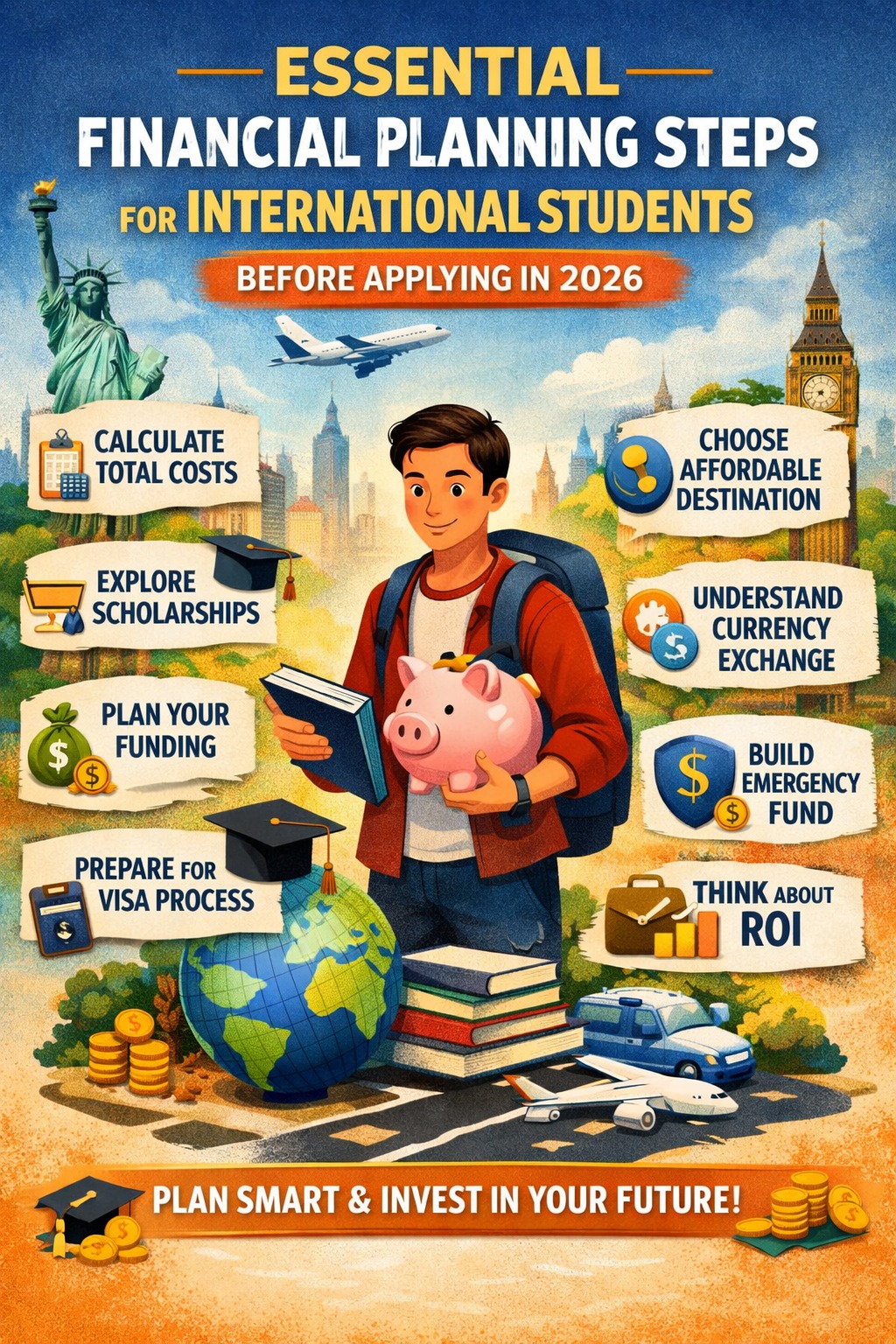
Introduction: Financial Planning Is Foundational
In 2026, studying abroad entails more than just selecting a university and passing an English test. It's a financial commitment that demands clarity, strategy, and long-term planning. Every year, hundreds of students make the mistake of arranging their academics while ignoring their finances, which is where issues begin.
Financial planning is essential if you want to develop a successful global career. It serves as your basis.
Step 1: Understand the True Cost: Beyond Tuition Fees
Most students concentrate solely on tuition expenses, yet this is only one aspect of the issue. You should calculate the full cost of study which includes more than just tuition.
The real expenses go far beyond the classroom fee.
- 💰 Living expenses (rent, food, and transportation)
- 🏥 Health Insurance
- ✈️ Visa and application fees
- 🛫 Flight tickets
- 🆘 Emergency funds
Pro Tip: Always Include a Buffer in Your Budget Estimates
Pro Tip: Always include a 10-15% buffer in your budget estimates. Unexpected charges are unavoidable.
For example, studying in Canada, the United Kingdom, or Australia demands proof of funds—not only for tuition but also for living expenses.
Step 2: Choose the Right Country Based on Budget, Not Only Trends
Many students follow trends rather than financial sense. Just because a country is popular does not imply it is within your budget.
Before finalising your destination, make a smart choice based on your financial reality, not trends or peer pressure.
- 📊 Compare the cost of living
- 💼 Check for part-time work opportunities
- 🌐 Understand the post-study work choices
- 📈 Evaluate return on investment (ROI)
Reality Check: Cost vs Career Prospects
Some countries may have lower tuition but less career prospects, affecting your return on investment (ROI). Choose wisely based on long-term value, not short-term savings.
Step 3: Plan Your Funding Sources Early
You should never rely on one source of funding. Education is typically funded through a combination of sources, and diversity is your safety net.
Create a balanced mix to reduce risk and ensure stability:
- 🏦 Family savings
- 📚 Educational loans
- 🎁 Scholarships
- 💼 Personal savings
Important: Education Loans Require Understanding
Education loans are widespread, but you need to understand:
Interest rates, repayment timelines and moratorium periods are critical factors. Smart move: Start looking into loan choices at least 6-8 months before applying.
Step 4: Target Scholarships Strategically
Scholarships are not limited to top performers. Many universities offer merit-based scholarships, need-based financial assistance, and country-specific grants.
The mistake that students make is to apply at random. Instead, apply with strategy:
- 🎓 Shortlist universities that provide financial aid
- 📅 Apply early (deadlines matter)
- 📝 Prepare solid SOPs and profiles
- ✨ Even a modest scholarship can help alleviate your financial load
Step 5: Create a Strong Financial Profile for Visa Approval
Visa officers do more than just review your documents; they also assess your financial soundness. You must demonstrate:
A clear source of funds, consistent bank statements and proper documentation are non-negotiable for visa approval.
- ✅ A clear source of funds
- ✅ Consistent bank statements
- ✅ Proper documentation
- ❌ Avoid sudden huge deposits
- ❌ Avoid unexplained transactions
Why This Matters for Visa Officers
A good financial profile significantly boosts your chances of obtaining a visa. Immigration officers look for stability and legitimacy, not just high numbers.
Step 6: Understanding Currency Exchange and Inflation Impact
Currency changes have a significant impact on your budget. For example, a slight increase in the currency rate can boost your total expenditure by lakhs.
Inflation in target nations impacts rent and daily expenses. Tip: Keep some of your money in an FX account or schedule your transfers intelligently.
Step 7: Plan for Part-Time Work—But Don't Rely on It
Yes, most countries allow for part-time work. However, it should only cover your expenses rather than fully fund your study.
Reality Check: Jobs aren't guaranteed, the initial months can be financially tough, and balancing employment and studying is tough. Always verify that your core expenses are covered.
- ❌ Jobs are not guaranteed
- ❌ Initial months can be financially tough
- ❌ Balancing work and studies is challenging
Step 8: Create an Emergency Financial Cushion
Living abroad is unpredictable. You may face medical emergencies, job delays or accommodation issues.
Keep at least 3-6 months of living expenditures in reserve. This cushion could mean the difference between stability and stress.
- 🏥 Medical emergency
- 💼 Job delays
- 🏠 Accommodation issues
Step 9: Think Long-Term: ROI Is Important
Don't just ask, "Can I afford this course?" Ask the more important questions:
Your goal should be financial growth, not simply foreign exposure.
- 🎯 Will this degree help me recoup my investment?
- 💰 What are my job prospects after graduation?
- 📊 What is the average wage in that field?
Step 10: Work with Experienced Guidance
Financial planning for study abroad can be complicated. A single error can cost you time, money, and potentially your visa. That is why dealing with experienced specialists is beneficial.
Professional guidance ensures:
- 📋 Proper budgeting
- 📚 Loan help and scholarship support
- 📄 Visa-ready financial documentation
Final Thoughts: Make Study Abroad a Smart Investment
Studying abroad in 2026 is a life-changing decision—but only if done correctly.
A well-structured financial strategy not only gets you to your destination, but it also ensures that you survive there without being stressed all the time. Remember, your dream country should not be a financial burden.
Your Action Plan
Start your financial planning today. Do not wait for admission letters to think about money. Here's your checklist:
- 📝 Calculate your complete cost of study
- 🎯 Decide on your target country and course
- 💰 Plan your funding sources
- 📊 Research scholarship opportunities
- 🏦 Explore education loan options
- 💵 Build your emergency fund
- 🤝 Seek professional financial and visa guidance
Ready to Plan Your Study Abroad Financial Strategy?
VisionWay has helped thousands of students plan their abroad journey with financial clarity from day one.
From course selection and financial planning to scholarship hunting and visa preparation, our team ensures you succeed without financial stress.
- 📞 Call 93624-93624 for a free financial consultation
- 📍 Visit your nearest VisionWay branch for detailed guidance
- 🧭 Start planning wisely, apply boldly, invest in your future