📢 Introduction
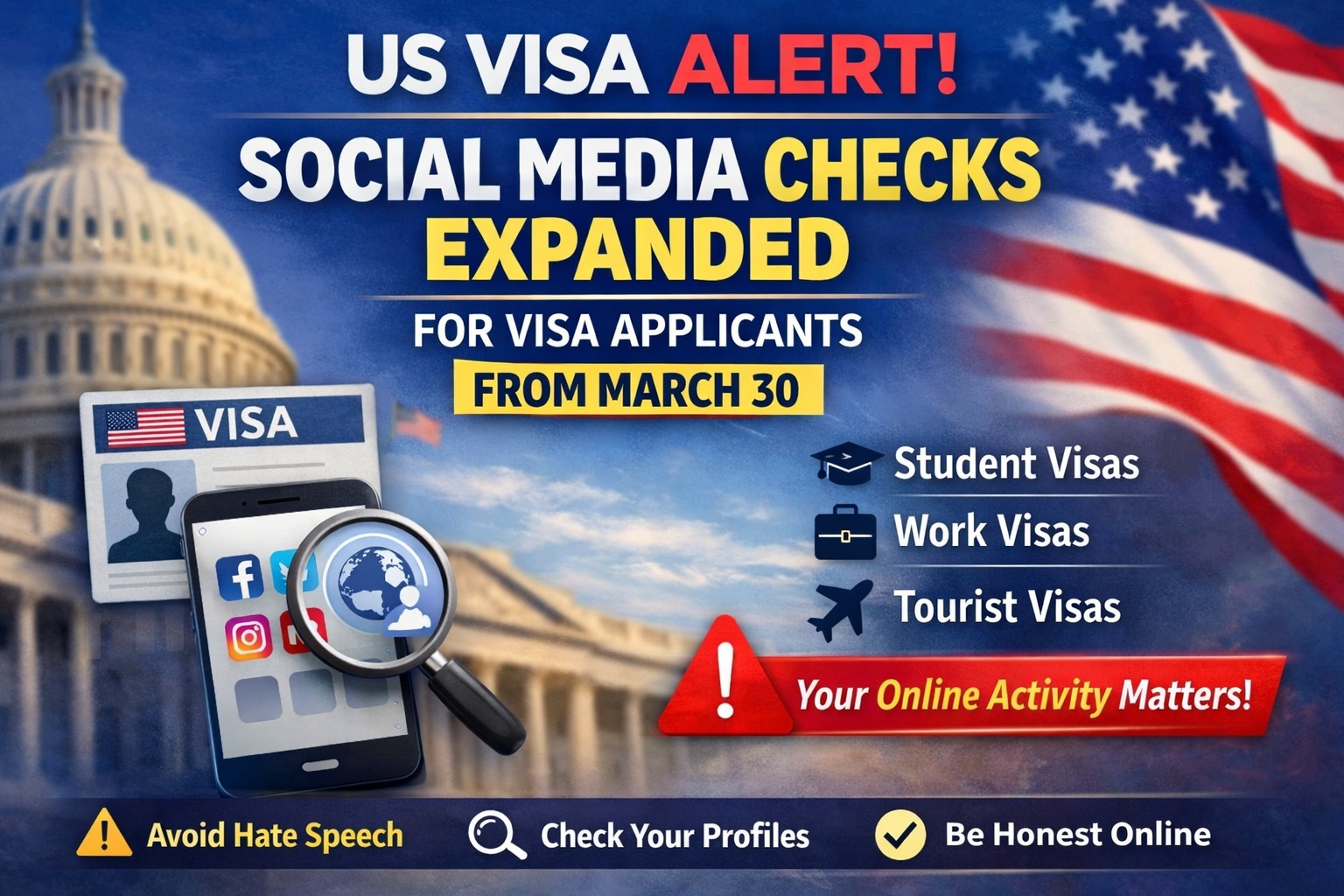
In a key move to strengthen immigration screening, the United States will expand social media background checks for visa applicants starting March 30, 2026.
This change is expected to impact a wider set of visa categories – including students, tourists and temporary workers – making your online presence more important than ever if you plan to study, work or travel to the US.
🔍 What Happened?
Previously, detailed social media checks were usually limited to certain visa types or higher-risk cases. Under the revised policy framework, digital background screening is expected to become more routine and structured.
- More visa categories may now undergo mandatory social media screening
- Applicants could be asked to provide social media handles used over the last 5 years
- Authorities may review public posts, interactions and overall online behaviour as part of risk assessment
📱 Which Visa Categories Are Affected?
While official implementation details are still being fine-tuned, the expanded social media checks are expected to touch a broad range of popular US visa categories.
- 🎓 Student visas (F-1, M-1) – your academics and financials still matter, but your digital footprint can now also be reviewed.
- 💼 Work visas (H-1B, L-1) – professionals may face closer checks on public posts, affiliations and online conduct.
- ✈️ Visitor / tourist visas (B1/B2) – even short-term travellers could be subject to online screening before a decision is made.
Why Is the US Doing This?
The wider use of social media checks is part of a broader global trend in immigration security. Governments are increasingly looking at open-source digital information to understand applicants better before granting entry.
Public online activity can provide signals about behaviour, risk factors or possible policy violations that may not be visible in standard paperwork.
- 🛡️ Detect potential security and compliance concerns earlier
- 📋 Prevent visa misuse and misrepresentation
- 📄 Check whether applicants appear to respect local laws and norms in their online presence
⚠️ Important Considerations for Visa Applicants
Your social media is now effectively part of your visa file. Even if you are genuine, careless posts or jokes can sometimes be misunderstood when seen outside context.
- Avoid content that could be seen as hate speech, harassment or discrimination.
- Stay away from posts suggesting political extremism, violence or illegal activities.
- Do not share or promote fake documents, misleading claims or suspicious offers.
- Maintain professional, respectful and consistent communication across platforms.
- Keep your name, education and work details truthful and aligned with your application.
🤝 Expert Tips for Staying Safe Online
If you intend to apply for a US visa soon, it is a good idea to review your online presence now and make sensible adjustments.
- ✔️ Review your past posts on platforms like Facebook, Instagram, X (Twitter) and LinkedIn.
- ✔️ Remove, archive or restrict visibility of content that might appear offensive, aggressive or irresponsible.
- ✔️ Update your privacy settings, but remember that public information may still be visible to authorities.
- ✔️ Use your real name and accurate details, avoiding multiple confusing identities.
- ✔️ Highlight positive activities such as academics, projects, volunteering and professional achievements.
📊 What This Means for Indian Students
For Indian students targeting US universities, the admissions process at universities is likely to remain similar, but visa-stage scrutiny can become more detailed.
A clean, consistent and mature online presence can quietly support your overall profile, while irresponsible posts may raise avoidable questions.
- Universities may continue to issue offers based on academics and profile, but consulates can review social media before issuing visas.
- Even casual online behaviour can be interpreted seriously during security checks.
- Maintaining a professional and responsible digital identity can only strengthen your chances.
🧠 Final Thoughts
The expansion of social media checks shows a new reality in immigration: your digital identity now travels with your documents.
Instead of seeing this as a threat, think of it as an opportunity to present yourself as a responsible, transparent and trustworthy applicant.
- Your online and offline identities should tell the same honest story.
- Avoid impulsive posts that could be misunderstood in a visa context.
- Start cleaning and aligning your digital presence well before you apply.
📲 Seeking Expert Advice?
If you are unsure how these changes might impact your specific case, expert guidance can help you prepare with confidence.
VisionWay supports students and professionals in preparing strong visa profiles, including interview preparation, documentation review and awareness of key immigration regulations.
- 📞 Call 93624-93624 for personalised advice
- 📍 Visit your nearest VisionWay branch for a one-to-one session
- ⏱️ Stay informed, stay prepared and stay ahead of policy changes