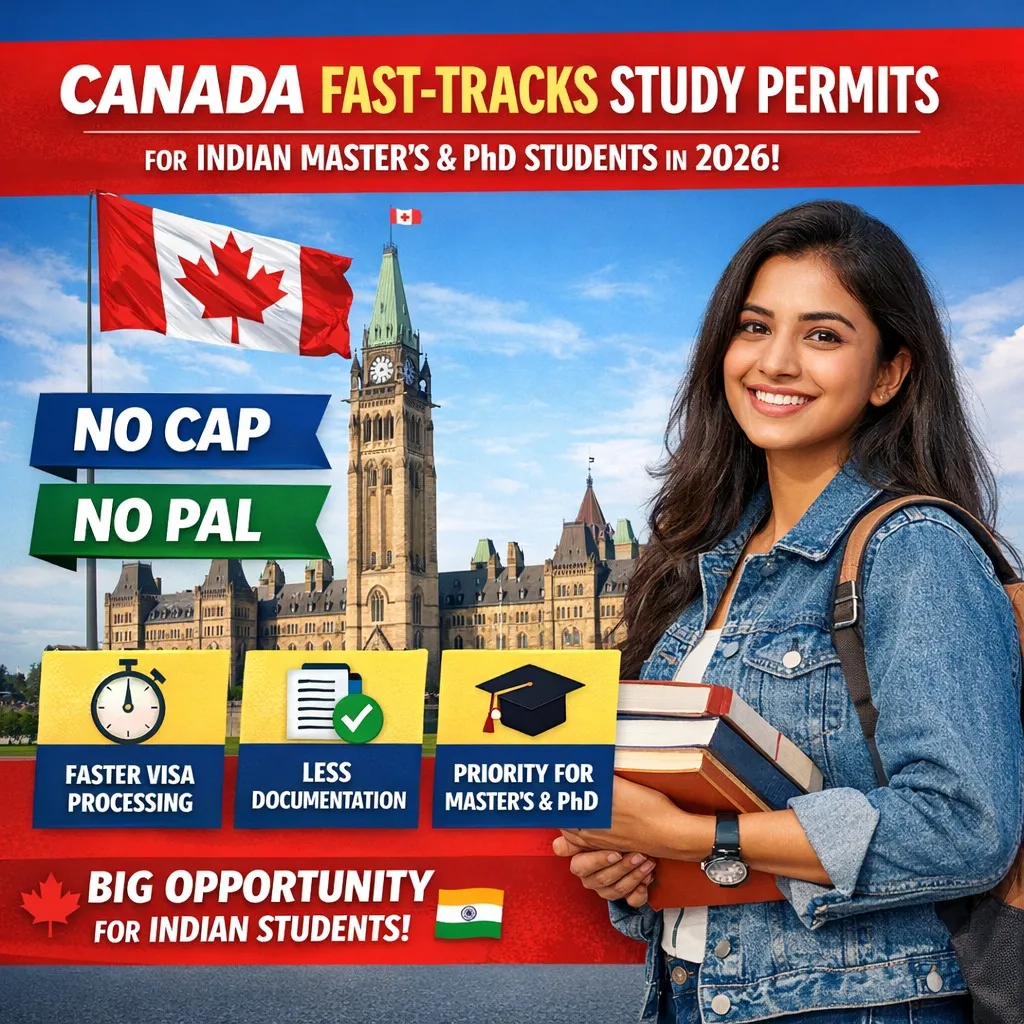
Canada 2026: Major Visa Fast-Track for Master's & PhD Students
If you're planning to pursue a Master's degree or PhD in Canada in 2026, there's major news that affects your visa application timeline.
Canada has introduced a significant policy change: **Master's and PhD students are now exempt from Provincial Attestation Letter (PAL) requirements**, dramatically speeding up visa processing.
This change directly benefits international students from India and other countries, removing a key bottleneck that previously caused visa delays of 2-4 weeks.
For thousands of Indian graduate students planning to study in Canada, this is a game-changer.
- ⚡ Master's & PhD students no longer need Provincial Attestation Letter (PAL)
- 🚀 Visa processing time reduced by 25-30%
- ✅ Fewer documentation requirements = faster approvals
- 🎓 Policy prioritizes high-level talent and research scholars
- 🇮🇳 Direct benefit for Indian applicants (largest source of grad students to Canada)
What Is the Provincial Attestation Letter (PAL) & Why Was It Required?
To understand why this change is significant, you need to know what PAL is and why it was slowing down graduate student visas.
- 📋 WHAT IS PAL (PROVINCIAL ATTESTATION LETTER)?
- A Provincial Attestation Letter is an official document issued by the Canadian province where you plan to study.
- It certifies that:
- • Your study program aligns with provincial needs
- • The institution and program are legitimate
- • The province has capacity to support international students
- • Your application meets provincial standards
- 🔴 WHY WAS PAL A PROBLEM?
- Before 2026:
- ❌ All international students needed PAL before visa approval
- ❌ Provincial offices were backlogged with requests
- ❌ Processing PAL added 2-4 weeks to visa timeline
- ❌ Some provinces slower than others (created inconsistency)
- ❌ Students couldn't book flights until PAL was issued
- ❌ Entire visa process delayed unnecessarily
- ✅ IN 2026 (NEW RULE):
- Master's and PhD students:
- ✓ Skip the PAL requirement entirely
- ✓ Apply directly for visa without provincial approval
- ✓ Faster processing = earlier visa approval
- ✓ Can book accommodation and flights sooner
- ✓ More predictable timeline
🎯 Who Benefits From This Change? Eligibility Criteria
Not all graduate students benefit equally. Here's who qualifies for fast-track processing without PAL requirements.
- ✅ YOU QUALIFY FOR FAST-TRACK IF YOU'RE APPLYING FOR:
- • Master's Degree Programs (any field)
- • PhD Programs (any discipline)
- • Graduate Diplomas (advanced level)
- • Postgraduate certificates (advanced programs)
- • Research-based programs
- ✅ YOU ALSO NEED:
- • Valid study permit application
- • Legitimate university acceptance letter
- • Financial proof (required as always)
- • English proficiency score (IELTS/TOEFL if required)
- • Valid passport
- • Clean background/security clearance
- ❌ YOU DO NOT QUALIFY IF:
- • Applying for undergraduate degree (still needs PAL)
- • Diploma/certificate programs (non-graduate level)
- • Language training programs
- • High school or preparatory programs
- • Some professional certification programs
- 💡 KEY POINT:
- Graduate level = Fast-track eligible
- Undergraduate level = Still requires PAL (unchanged)
⏱️ How Much Faster Is the New Process?
Let's look at the actual timeline improvements for Master's and PhD students applying in 2026.
- 📊 VISA PROCESSING TIMELINE COMPARISON
- 🔴 BEFORE 2026 (WITH PAL REQUIREMENT):
- Step 1: Submit visa application → 1-2 weeks
- Step 2: Immigration requests PAL from province → 1 week
- Step 3: Province reviews and issues PAL → 2-4 weeks
- Step 4: Immigration reviews PAL + application → 1-2 weeks
- Step 5: Final visa decision → 1 week
- TOTAL TIMELINE: 6-10 weeks (average 8 weeks)
- 🟢 AFTER 2026 (PAL REMOVED FOR GRAD STUDENTS):
- Step 1: Submit visa application → 1-2 weeks
- Step 2: Immigration reviews application → 2-3 weeks
- Step 3: Final visa decision → 1-2 weeks
- TOTAL TIMELINE: 4-7 weeks (average 5 weeks)
- ⚡ TIME SAVED: 2-3 weeks faster
- 📈 IMPROVEMENT: 25-30% faster processing
- 💰 REAL-WORLD IMPACT:
- • Can attend university mid-semester instead of waiting
- • Earlier access to student housing
- • More time to arrange logistics
- • Book flights at better prices with confirmed dates
- • Start work permit process earlier
🇮🇳 Why This Matters for Indian Students
India is one of Canada's largest sources of international students. This policy change has outsized impact on Indian applicants.
- 📊 INDIAN STUDENTS & CANADA (2026 DATA)
- • Indian students: ~280,000+ studying in Canada
- • Master's students from India: ~80,000+ annually
- • PhD students from India: ~15,000+ annually
- → Total graduate students from India: ~95,000+
- ✅ DIRECT BENEFITS FOR INDIANS:
- 1. Faster visa approval means earlier semester start
- 2. Less uncertainty for family planning and finances
- 3. Can secure scholarships faster (timelines important)
- 4. Better accommodation availability (earlier booking)
- 5. More predictable cost planning
- 💡 BROADER IMPACT:
- India-Canada Education Movement:
- • Removes barrier to Indian graduate students
- • Attracts more high-quality applicants
- • Strengthens Canada's appeal vs. Australia/UK
- • Positions Canada as graduate-friendly destination
- 🎯 COMPETITIVE ADVANTAGE:
- Canada now competes more effectively with:
- • Australia (strong graduate programs)
- • UK (premium but faster)
- • USA (popular but expensive)
- → By reducing wait times, Canada becomes more attractive
📋 Step-by-Step: How to Apply for Master's/PhD in Canada (2026 Process)
Here's exactly what the streamlined application process looks like with the new PAL exemption.
- ✅ STEP 1: Choose Your University & Program (Weeks 1-4)
- • Research Canadian universities (top 100 preferred)
- • Check program requirements and admission criteria
- • Prepare GRE/GMAT if required
- • Gather transcripts and academic documents
- ✅ STEP 2: Submit University Application (Weeks 4-8)
- • Complete online application
- • Submit transcripts, CV, Statement of Purpose
- • Secure letters of recommendation (2-3)
- • Pay application fee
- • Track application status
- ✅ STEP 3: Receive Acceptance Letter (Weeks 8-12)
- • University sends acceptance or rejection
- • If accepted, receive official acceptance letter
- • Letter includes program details and conditions
- • If conditional, fulfill requirements immediately
- ✅ STEP 4: Prepare Financial Documentation (Weeks 12-16)
- • Calculate total study costs + living expenses
- • Gather proof of funds:
- - Bank statements (6+ months)
- - Tax returns (parents)
- - Employment letters
- - Property documents
- • Arrange GIC (Guaranteed Investment Certificate) if applicable
- ✅ STEP 5: Start Study Permit Application (Weeks 16-18)
- • Create application on Immigration portal
- • Upload all documents:
- - Acceptance letter
- - Financial proof
- - Passport
- - Birth certificate
- • Pay application fee (~₹20,000-25,000)
- • Submit application
- ✅ STEP 6: Wait for Approval (Weeks 18-23)
- • Immigration reviews application (2-3 weeks)
- • **NO PAL REQUEST** (this is the time saved!)
- • May request additional documents (1 week)
- • Final decision issued (1-2 weeks)
- ✅ STEP 7: Receive Study Permit (Week 23)
- • Approval letter sent via email
- • Contains permit details
- • Allows you to travel to Canada
- ✅ STEP 8: Arrange Travel & Logistics (Weeks 23-28)
- • Book flights to Canada
- • Arrange accommodation (on-campus or off-campus)
- • Get travel insurance
- • Arrange initial funds transfer
- • Plan arrival
💼 Post-Graduation Benefits: PGWP & Career Prospects
The time saved by faster visa processing is just the beginning. Master's and PhD graduates in Canada have excellent post-study work opportunities.
- 🎓 POST-GRADUATION WORK PERMIT (PGWP)
- Master's Degree Holders:
- • PGWP Duration: Up to 3 years
- • Can work for any employer
- • Can work in any field (not restricted)
- • Valuable for PR applications
- PhD Degree Holders:
- • PGWP Duration: Up to 3 years
- • Priority for research positions
- • Strong employer preference
- • Direct pathway to PR
- 💰 SALARY PROSPECTS POST-GRADUATION
- Master's Graduates (First Year):
- • Average salary: CAD $55,000-75,000 (₹32-44 lakhs)
- • Tech roles: CAD $70,000-90,000 (₹41-53 lakhs)
- • Business roles: CAD $60,000-80,000 (₹35-47 lakhs)
- PhD Graduates (First Year):
- • Average salary: CAD $65,000-85,000 (₹38-50 lakhs)
- • Research roles: CAD $70,000-100,000 (₹41-59 lakhs)
- • Academic roles: CAD $75,000-110,000 (₹44-65 lakhs)
- 🛤️ PR PATHWAY
- Master's graduates:
- ✓ 1-2 years of Canadian work experience
- ✓ Canadian degree + work experience = PR eligible
- ✓ Express Entry fast-track available
- ✓ Realistic PR timeline: 2-3 years total
- PhD graduates:
- ✓ Often eligible for PR directly after graduation
- ✓ Research experience highly valued
- ✓ Can apply while still studying (in some cases)
- ✓ Realistic PR timeline: 1-2 years total
❓ Frequently Asked Questions: Master's & PhD Visas 2026
Here are answers to the most common questions about Canada's new fast-track graduate visa process.
- Q1: "Do all Master's students get the PAL exemption?"
- A: Yes, all Master's degree students benefit. This includes thesis-based, course-based, and professional Master's programs.
- Q2: "What about MBA programs? Are they exempt too?"
- A: Yes, MBA and other graduate business programs qualify for the fast-track (PAL exemption).
- Q3: "How much faster is the visa processing really?"
- A: Average 2-3 weeks faster. Most graduate visas now process in 4-7 weeks instead of 6-10 weeks.
- Q4: "Do I still need to show financial proof?"
- A: Yes, absolutely. Financial documentation is still required. The PAL exemption only removes the provincial letter requirement, not financial proof.
- Q5: "What if my university is in a province with low capacity?"
- A: No longer an issue! Without PAL requirements, provincial capacity is no longer a bottleneck.
- Q6: "Is this exemption permanent or temporary?"
- A: Canada has made this permanent policy change. It's not temporary—this is the new standard.
- Q7: "Does this help with funding applications?"
- A: Indirectly yes. Faster visa approval means you can submit scholarship applications earlier and have confirmed funding sooner.
- Q8: "What about undergraduate students? Do they get PAL exemption too?"
- A: No. PAL requirement remains for undergraduate programs. Exemption is graduate-only (Master's, PhD, postgraduate).
- Q9: "Can I apply for Master's and PhD programs simultaneously?"
- A: Yes, and both applications will benefit from the faster processing if accepted.
- Q10: "Is this exemption also for international students from other countries or just India?"
- A: This applies to all international students pursuing Master's and PhD in Canada, regardless of origin country.
✨ Your Action Plan: Master's/PhD in Canada 2026
If you're considering a Master's or PhD in Canada, here's your step-by-step action plan to capitalize on the faster visa processing:
- 📅 TIMELINE: 6-8 Months Before Your Target Start Date
- ✅ MONTH 1: Research & Shortlist
- • Identify 8-10 target universities
- • Research program details, admission requirements
- • Connect with potential advisors (especially for PhD)
- • Prepare GRE/GMAT if required
- ✅ MONTH 2-3: Applications Submitted
- • Complete university applications
- • Submit official transcripts
- • Submit CV and Statement of Purpose
- • Arrange letters of recommendation
- • Pay application fees
- ✅ MONTH 4: Acceptances & Financial Planning
- • Receive acceptances (exciting!)
- • Compare offers and scholarships
- • Accept final offer with confirmation
- • Calculate total costs
- • Arrange funds (loans, family, savings)
- ✅ MONTH 5: Study Permit Application
- • Gather all financial documents
- • Get notarization if needed
- • Upload documents to application portal
- • Submit study permit application
- ✅ MONTH 5-6: Visa Processing (FASTER NOW!)
- • Wait for approval (4-7 weeks typical)
- • Provide additional info if requested (quick turnaround)
- • Receive positive decision
- ✅ MONTH 6-7: Final Arrangements
- • Book flights
- • Arrange accommodation
- • Get travel insurance
- • Plan arrival date
- ✅ MONTH 7-8: Departure
- • Arrive in Canada
- • Settle into student life
- • Begin your Master's/PhD program
🎓 The Bottom Line: Why This Matters
Canada's decision to fast-track Master's and PhD visas by removing provincial attestation letter requirements is a major win for graduate students.
Here's why it matters:
✅ **Faster = Better**: 2-3 weeks faster means predictable timelines for planning
✅ **Signals Priority**: Canada is positioning itself as graduate-friendly
✅ **Competitive Advantage**: Makes Canada more attractive vs. Australia, UK, USA
✅ **Indian Focus**: Directly benefits India (largest source of grad students)
✅ **PR Pathways**: Faster entry = earlier access to post-study work + PR opportunities
If you're considering a Master's or PhD in Canada, **2026 is an ideal time to apply**. The streamlined process means faster approvals, earlier arrival, and better preparation for your graduate studies.
- 🚀 Master's/PhD visa processing: 2-3 weeks faster
- 📋 No provincial approval letter needed
- ✅ Fewer bureaucratic delays
- 💼 Better career prospects post-graduation
- 🇮🇳 Direct benefit for Indian students
- 🎓 Strategic advantage for graduate students