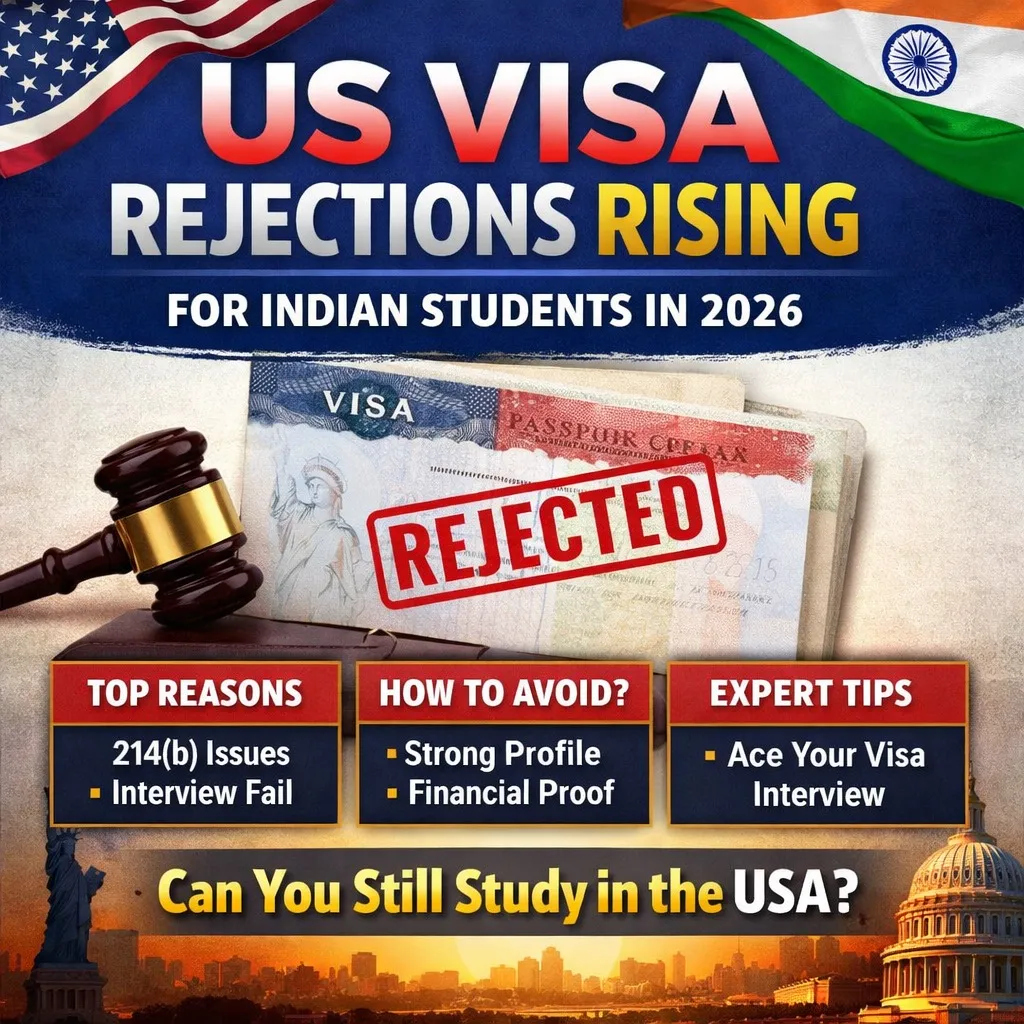
USA F-1 Visa Trends 2026: A New Reality for Indian Students
The dream of studying in the United States remains strong for Indian students in 2026. However, the landscape has shifted significantly.
While applications continue to rise, visa approval rates are becoming more competitive. More students are facing unexpected rejections—even those with exceptional academic profiles.
What has changed? Why are rejections increasing? And most importantly, how can you ensure your F-1 visa approval?
This guide separates fact from fiction and provides actionable strategies to strengthen your visa application.
- 📈 Rising F-1 visa applications from Indian students (+23% YoY)
- ⚠️ Increased scrutiny during visa interviews
- 🎯 Stricter focus on verifying non-immigrant intent
- 💼 Greater emphasis on genuine study purpose vs. immigration intent
- 📋 Enhanced document verification and background checks
📊 Current USA F-1 Visa Statistics for Indian Students (2026)
Understanding the numbers helps you contextualize your application within the broader landscape.
- ✓ Total F-1 visa applications from India: ~95,000+ (2026)
- ✓ Approval rate: 85-88% overall
- ✓ Refusal rate: 12-15% (Section 214(b) primarily)
- ✓ Peak rejection season: May-July (summer intake peak)
- ✓ Top states for approvals: CA, TX, NY, MA, IL
- ✓ Most common refusal reason: Lack of non-immigrant intent (214b)
- ✓ Second reason: Insufficient financial documentation
❌ Top 5 Reasons for F-1 Visa Rejection in 2026
The majority of rejections fall into predictable categories. Understanding these reasons is the first step to avoiding rejection.
- 1️⃣ INSUFFICIENT NON-IMMIGRANT INTENT (Section 214b)
- • Most common reason (45-50% of rejections)
- • Consular officers must believe you'll return to India
- • Weak ties to home country raises red flags
- • Vague career plans make officers suspicious
- 2️⃣ WEAK OR UNCLEAR ACADEMIC CREDENTIALS
- • Poor TOEFL/IELTS scores relative to program
- • Low GPA unexplained by profile narrative
- • Mismatch between academic level and chosen program
- • Gaps in educational timeline
- 3️⃣ INADEQUATE FINANCIAL DOCUMENTATION
- • Unclear source of funds
- • Bank statements lacking recent history
- • Funds appearing too recent (red flag for loans)
- • No evidence of sponsor's financial stability
- • Inconsistent financial claims vs. documents
- 4️⃣ POOR VISA INTERVIEW PERFORMANCE
- • Nervous or evasive answers
- • Inconsistent responses about university choice
- • Inability to explain program details
- • Low confidence or scripted-sounding answers
- • Language barrier affecting communication
- 5️⃣ WEAK TIES TO INDIA
- • No family or property in India
- • Unemployed parents or unstable income
- • No demonstrated commitment to return
- • History of overstays in other countries
- • Weak professional prospects in India
🎯 How to Prove Non-Immigrant Intent (Most Critical Factor)
Section 214(b) rejections dominate F-1 visa refusals. Officers must believe you'll return to India after studies.
Here's how to build an undeniable case:
- ✅ DEMONSTRATE STRONG TIES TO INDIA:
- • Family members living permanently in India
- • Parental employment with long tenure
- • Property/real estate ownership in India
- • Joint family structure with responsibilities
- • Active social/community involvement
- ✅ CLEAR CAREER ROADMAP BACK TO INDIA:
- • Specific career plans requiring USA degree
- • Identified industry/sector in India seeking this skill
- • Named companies/opportunities requiring this qualification
- • Clear timeline: Study → Work in USA → Return to India
- • How the degree advances your Indian career
- ✅ STRATEGIC UNIVERSITY SELECTION:
- • Choose programs aligning with Indian market needs
- • Research universities known for alumni returning to India
- • Select career-focused programs (not permanent residence programs)
- • Avoid programs heavily associated with immigration
- ✅ ARTICULATE YOUR PURPOSE CLEARLY:
- • Why THIS university specifically?
- • Why THIS program over alternatives?
- • How does this enhance your Indian career?
- • What makes you a good candidate?
- • Practice responses until natural (not scripted)
💰 Financial Documentation: The Critical Window
Visa officers examine financial documents with extreme scrutiny. Your family must show legitimate, traceable sources of funds.
- ✅ DOCUMENTS YOU MUST PREPARE:
- • Bank statements (minimum 6 months history)
- • Income tax returns (last 2 years for both parents)
- • Employment letters (current position, salary, tenure)
- • Property ownership documents/tax receipts
- • Business registration & financial records (if self-employed)
- • Affidavit of support (if sponsor is third party)
- • Investment portfolio statements (stocks, bonds, FDs)
- ⚠️ COMMON FINANCIAL RED FLAGS TO AVOID:
- ❌ Suspicious large deposits just before visa application
- ❌ Unexplained gaps in bank statements
- ❌ Inconsistent or vague fund source explanations
- ❌ Unsecured loans or borrowed money
- ❌ Forged or altered documents
- ❌ Mismatched stated funds vs. actual documents
- ✅ BEST PRACTICES FOR FINANCIAL PROOF:
- • Maintain consistent savings pattern (avoid sudden deposits)
- • Document all income sources with tax filings
- • Get notarized affidavits if using sponsor support
- • Prepare written explanation for any large transactions
- • Bring original + certified copies to interview
- • Practice explaining your financial situation clearly
🎤 Mastering the F-1 Visa Interview
Your interview is where everything comes together. Officers spend 3-5 minutes determining your fate. Make every word count.
- ✅ INTERVIEW PREPARATION CHECKLIST:
- • Know your university's location, size, reputation
- • Understand your program curriculum in detail
- • Research program faculty and research areas
- • Prepare 3-4 reasons why THIS university
- • Articulate how degree helps your Indian career
- • Practice responses until natural and confident
- 📋 LIKELY INTERVIEW QUESTIONS:
- Q: "Why do you want to study in the USA?"
- A: Focus on career advancement, not immigration
- Q: "What will you do after graduation?"
- A: Clearly state plans to return to India
- Q: "Why this university?"
- A: Specific reasons, not generic responses
- Q: "How will your family fund your studies?"
- A: Clear, documented source with evidence
- Q: "Do you have family in the US?"
- A: Honest answer; tie to India if in USA
- ✅ INTERVIEW DELIVERY TIPS:
- • Speak confidently but naturally
- • Make eye contact with the officer
- • Answer questions fully but concisely
- • Never appear scripted or rehearsed
- • Dress professionally and formally
- • Bring all original documents, organized
- • Be honest—fabrications are easily caught
- • Show genuine enthusiasm for your program
🏫 Strategic University Selection
Your choice of university significantly impacts interview success. Avoid universities commonly associated with visa abuse or immigration fraud.
- ✅ CHOOSE UNIVERSITIES THAT ARE:
- • Ranked in top 500 globally
- • Well-established with long track records
- • Known for alumni returning to home countries
- • Regionally accredited and recognized
- • Have strong international student support
- ⚠️ AVOID RED FLAGS:
- • Universities heavily recruiting international students
- • Schools with few/no US students
- • Programs not aligned with career goals
- • Schools with history of visa fraud
- • Online-only or less established institutions
- 💡 PRO TIP:
- Research university rankings, employment outcomes,
- and alumni success in India. Show this research
- during your interview to prove genuine interest.
❓ Frequently Asked Questions About F-1 Visa Rejection
Here are answers to the most common questions we receive from Indian students:
- Q1: "What is Section 214(b) exactly?"
- A: It's the immigration law allowing consular officers to refuse visas if applicants fail to prove non-immigrant intent (plan to return). It's not personal—it's standard procedure.
- Q2: "Can I reapply for F-1 visa after rejection?"
- A: Yes. Wait 2-3 months, strengthen your profile, address refusal reasons, and reapply. Most reapplicants succeed.
- Q3: "How do I strengthen my application after rejection?"
- A: Get admission to a different/better university, secure more financial documentation, get employed (improve ties to India), or gather supporting letters.
- Q4: "Do rejections go on my record?"
- A: Rejections are recorded but are NOT permanent disqualifications. You can reapply without penalty.
- Q5: "Is the US student visa market saturated in 2026?"
- A: Not saturated, but more competitive. Officers are careful with each application. Strong applications still succeed at 85%+ rates.
- Q6: "Should I hire a visa consultant?"
- A: It helps for complex cases, weak profiles, or previous rejections. Not necessary if your profile is strong.
- Q7: "What's the best time to apply for F-1 visa in 2026?"
- A: Apply 4-6 months before your intended semester. Avoid summer rush (peak rejections).
- Q8: "Does GPA matter for F-1 visa approval?"
- A: Only as evidence of academic capability. 3.0+ is ideal. Below 2.5 requires extra explanation.
🚀 Your Action Plan: 6 Steps to F-1 Visa Success
Don't wait for your interview date to prepare. Start building your case now:
- ✅ STEP 1: Choose Your University Strategically
- • Research top-ranked programs in your field
- • Verify university credibility and alumni outcomes
- • Select program matching your career goals
- Deadline: 2-3 months before application
- ✅ STEP 2: Organize Financial Documentation
- • Collect 6+ months bank statements
- • Gather tax returns and employment letters
- • Get property documents notarized if applicable
- • Prepare written explanations for large transactions
- Deadline: 3-4 months before application
- ✅ STEP 3: Build Your Narrative
- • Document strong ties to India (family, property, job prospects)
- • Create clear career roadmap showing why this degree matters
- • Write compelling Statement of Purpose
- • Prepare 3-5 reasons specific to chosen university
- Deadline: 2-3 months before visa interview
- ✅ STEP 4: Practice Your Interview
- • Mock interview with mentor/consultant
- • Practice answers until natural (not scripted)
- • Record yourself to improve delivery
- • Prepare for tough questions calmly
- Deadline: 2 weeks before interview
- ✅ STEP 5: Compile Your Interview Packet
- • Organize all documents in logical order
- • Create document checklist
- • Prepare backup copies of critical papers
- • Print university program details for reference
- Deadline: 1 week before interview
- ✅ STEP 6: Final Interview Preparation
- • Review your answers one more time
- • Get 8 hours sleep before interview
- • Arrive 30 minutes early to consulate
- • Dress professionally and formally
- • Stay calm—you've prepared well!
💪 The Bottom Line: Your F-1 Visa Success Is Achievable
While USA F-1 visa requirements are stricter in 2026, approval remains highly achievable for well-prepared applicants.
The key is understanding what consular officers want: **assurance that you're a genuine student who will return to India.**
Approach your application strategically, prepare thoroughly, and present your case confidently. Most rejections are preventable with proper planning.
- 🎯 Strong Profile + Clear Narrative = Visa Success
- 📋 Document Everything, Explain Nothing Vaguely
- 💬 Master Your Interview Through Practice
- 🇮🇳 Emphasize Your Indian Ties & Career Goals
- ✨ Confidence, Clarity & Conviction = Approval