Digital Marketing Education in the UK: An Overview
The UK is a global hub for digital marketing education, attracting thousands of Indian students annually. Universities across the UK offer industry-leading programs that combine theoretical knowledge with practical, real-world experience.
The best course for you depends on your educational background: whether you're studying after completing 12th grade or pursuing advanced qualifications after your bachelor's degree.
- 🌍 World-class digital marketing programs
- 💼 Industry-focused curriculum with real projects
- 🏢 Strong placement rates in top companies
- 📱 Latest tools and technologies taught
- 👥 Diverse student community from across the globe
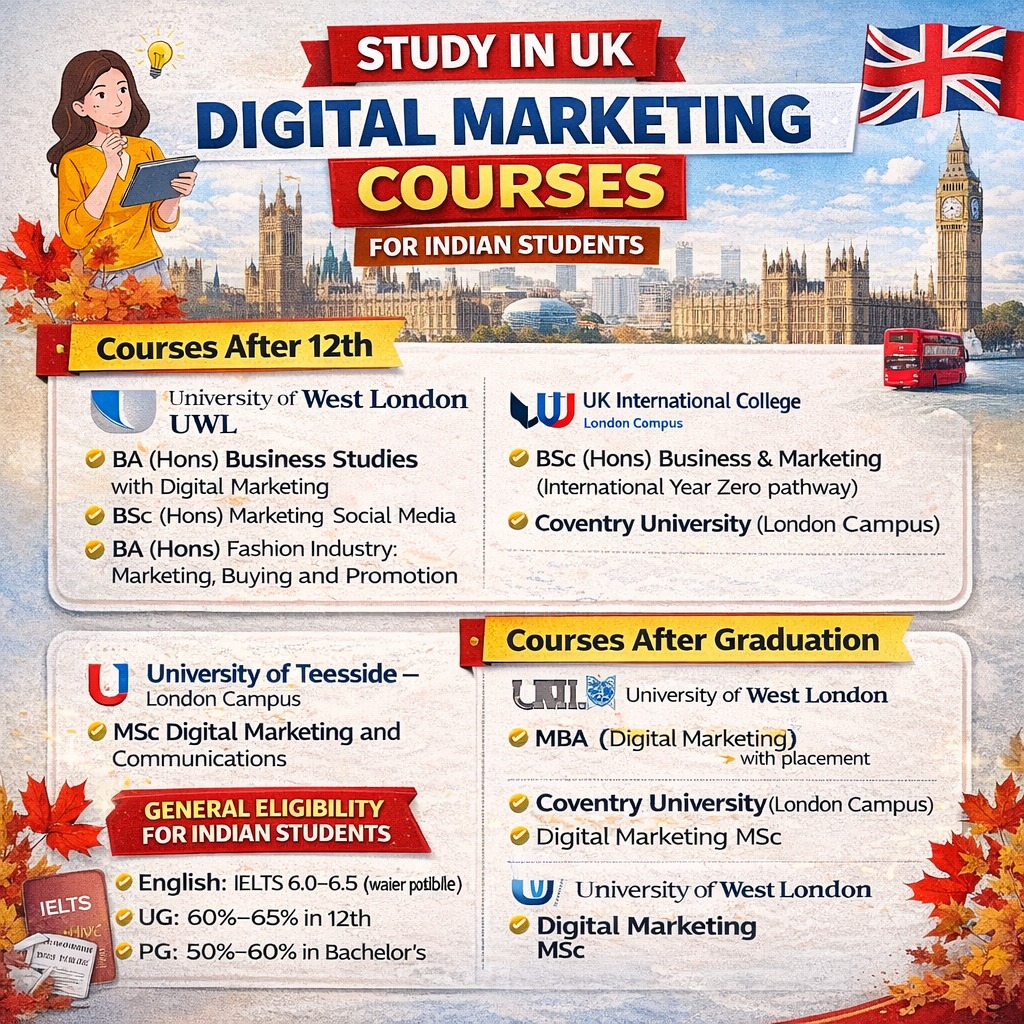
Undergraduate Digital Marketing Courses (Post-12)
If you've completed your 12th grade (CBSE, ICSE, or State Board), you can apply directly to bachelor's degree programs in digital marketing and related fields. These programs typically last 3 years and provide a comprehensive foundation in marketing fundamentals and digital strategies.
Most UK universities accept Indian 12th grade students through foundation year programs or direct pathways.
- 🏫 University of West London (UWL) - BSc (Hons) Marketing and Social Media
- 🏫 UWL - BA (Hons) Business Studies with Digital Marketing
- 🏫 UWL - BA (Hons) Fashion Industry: Marketing, Purchasing, and Promotion
- 🏫 UK International College (UKIC) - BSc (Hons) Business and Marketing (International Year Zero pathway)
- 🏫 Coventry University (London Campus) - BA (Hons) Marketing with Consumer Psychology
- 💡 These courses build solid foundations in digital platforms, branding, and consumer behavior
Postgraduate Digital Marketing Programs (After Bachelor's)
If you already have a Bachelor's degree (BBA, BCom, BA, or equivalent), you can pursue Master's or MBA programs specialized in digital marketing. These intensive 1-2 year programs are perfect for professionals looking to advance their careers with specialized expertise.
Postgraduate programs offer higher-level strategic insights, industry partnerships, and placement opportunities in leading companies.
- 🏫 Teesside University (London Campus) - MSc in Digital Marketing and Communications (1-2 year options)
- 🏫 University of West London (UWL) - Extended MSc Digital Marketing (suitable for 40-59% graduates)
- 🏫 Coventry University (London Campus) - MSc Digital Marketing
- 🏫 UK International College (UKIC) - MSc Digital Marketing & Analytics (International Incorporated Masters pathway)
- 🏫 University of East London (UEL) - MBA (Digital Marketing) with placement year
- 💡 These provide advanced skills, industry exposure, and enhanced global career prospects
English Language Requirements
All UK universities require proof of English language proficiency for international students. The most common accepted qualification is the IELTS (International English Language Testing System) exam.
However, there are alternative pathways for students who meet specific academic criteria in their previous education.
- 📝 IELTS Score: 6.0 to 6.5 bands (most universities)
- ✅ IELTS Waiver Possible: If you scored 70-75%+ in English in 12th grade (CBSE/ICSE/selected state boards)
- 🎓 Pearson Test of English (PTE): Alternative to IELTS
- 💻 TOEFL: Accepted at some universities
- ⏰ Most universities require overall IELTS 6.5 with no band below 6.0
Academic Eligibility Requirements
Your academic qualifications determine both your eligibility and the type of program you can enroll in. Different universities have varying minimum percentage requirements.
It's important to understand that extended programs or foundation years offer flexibility for students with lower scores while maintaining educational quality.
- 🎓 Undergraduate Programs (Post-12 Students): 12th grade pass certificate required
- 🎓 Standard Postgraduate Programs: Minimum 60-65% in Bachelor's degree
- 🎓 Extended/Incorporated Masters Programs: Minimum 50-60% in Bachelor's degree
- 🎓 Extended Master's Programs at UWL: Accept as low as 40% aggregate (with extended curriculum)
- 📊 Higher grades improve scholarship eligibility and course options
Key Universities & Course Comparison
Here's a quick comparison of top universities offering digital marketing courses suited for Indian students. Each has unique strengths and supports students through the visa process.
Consider location, fee structure, career support, and campus facilities when making your choice.
- 🏢 University of West London - Flexible entry criteria, extended programs available, affordable tuition
- 🏢 Coventry University (London Campus) - Strong industry links, excellent placement rates, modern facilities
- 🏢 UK International College (UKIC) - Pathway programs, affordable, good support systems
- 🏢 Teesside University (London) - Specialized digital marketing focus, modern curriculum
- 🏢 University of East London (UEL) - Placement year options, diverse student body, good value
- 💡 Most offer dedicated international student services and visa sponsorship
IELTS: Not Always Mandatory
A common misconception is that IELTS is always required. However, if you studied in English medium throughout your schooling and scored well in English, many universities will waive this requirement.
This can save you time and money, allowing you to apply immediately to your desired program.
- ✅ IELTS Waiver Eligibility: 70-75%+ in English (12th grade)
- ✅ English Medium School: Automatic waiver at most universities
- ⏰ IELTS Score Validity: 2 years from test date
- 💰 IELTS Cost: ₹15,000-17,000 in India
- 📋 Always check with universities for their specific waiver policies
Visa & Financial Requirements
Beyond academics and language requirements, you'll need to demonstrate your financial capacity to support yourself in the UK. The Student Visa (Tier 4/Skilled Worker Visa) requires proof of funds.
Most universities provide fee information upfront to help with financial planning.
- 💰 Annual Tuition (Undergraduate): £12,000-18,000
- 💰 Annual Tuition (Postgraduate): £14,000-20,000
- 💰 Living Costs: £12,000-15,000 annually
- 💰 International student visa fee: £719
- ⏳ Healthcare surcharge: £624 annually
- 👨👩👧👦 Bank statements typically required for last 28 days
Career Prospects After Digital Marketing Studies
One of the biggest advantages of studying digital marketing in the UK is the door it opens for your career. UK graduates are sought after globally for their practical skills and strategic thinking.
Most universities have strong industry connections and offer placement support.
- 🚀 Post-Study Work Visa: 2 years for Bachelor's, 3 years for Master's
- 💼 Career roles: Digital Marketing Manager, SEO Specialist, Content Strategist, Social Media Manager
- 🌍 Global recognition of UK degrees in marketing and business
- 💻 High demand for digital marketing professionals worldwide
- 📈 Average salary growth post-study: 40-60% increase within 2 years
- 🤝 Alumni networks provide ongoing career support
Step-by-Step Application Process
The application process for UK universities is straightforward but requires careful planning. Starting early gives you the best chance of admission and scholarship opportunities.
Most universities accept applications year-round, with peak intake in September and some in January.
- 1️⃣ Choose your course and university
- 2️⃣ Prepare documents: 12th mark sheet or Bachelor's degree certificate, English language proof
- 3️⃣ Submit online application via university website or UCAS (for undergraduates)
- 4️⃣ Attend interview (often virtual for international students)
- 5️⃣ Receive offer letter and accept
- 6️⃣ Arrange finances and apply for Student Visa
- 7️⃣ Receive Visa approval and enroll
Final Advice: Making the Right Choice
Choosing the right digital marketing program in the UK is a significant decision that will shape your career. Focus on finding a university and program that align with your goals, academic background, and financial situation.
Don't hesitate to reach out to universities directly or seek guidance from experienced education consultants to make an informed decision.
- 🎯 Match your academics to appropriate course level
- 💭 Consider your career goals (agency, corporate, freelance, etc.)
- 📍 Think about location and campus culture
- 💰 Compare fees and scholarship opportunities
- 🤝 Look for universities with strong placement support
- 📞 Connect with current students for first-hand experiences